


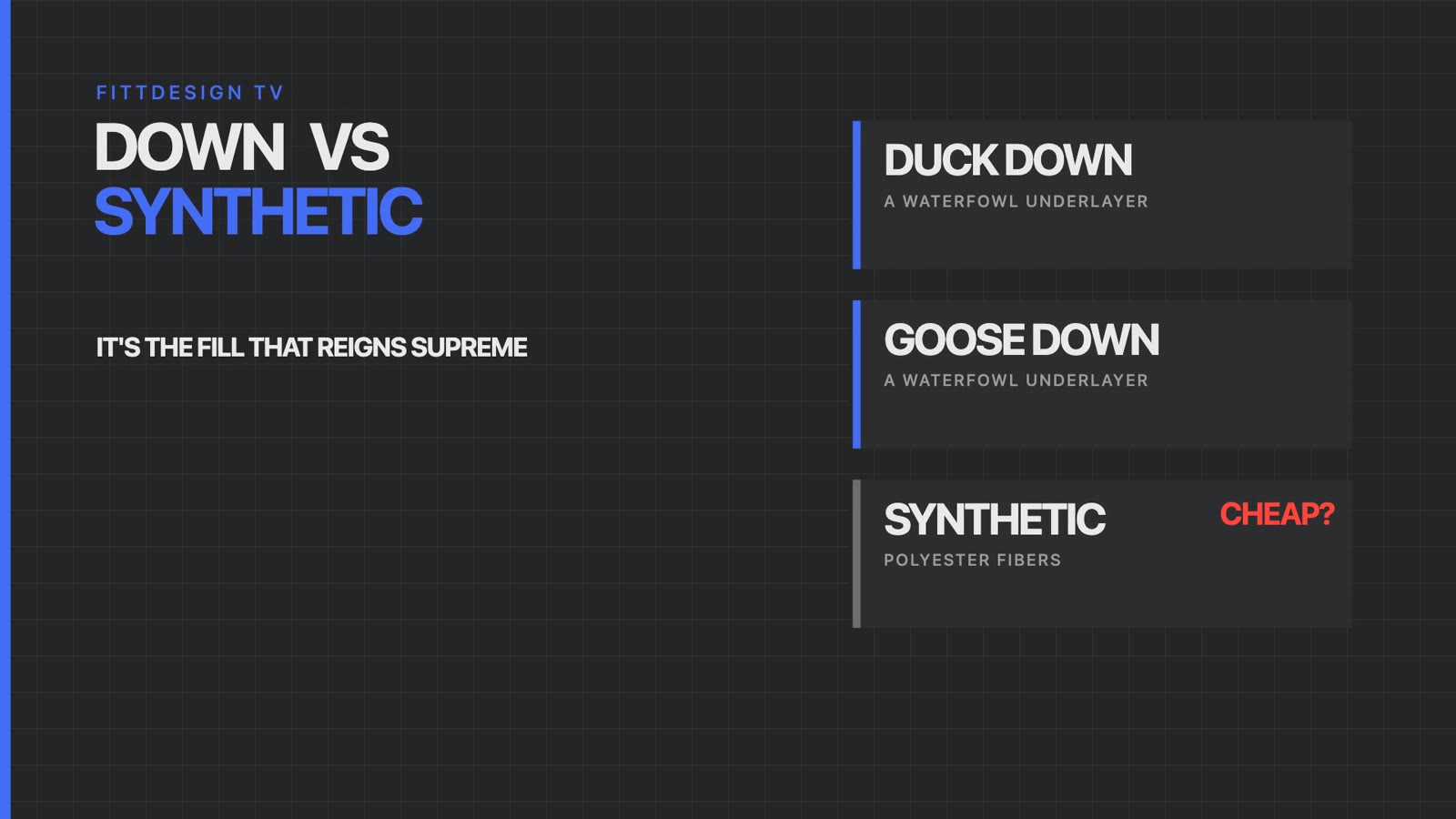
You're in a store holding two puffer jackets. Same size, same cut, same shine, same stitching lines. One feels lightweight and the other feels almost double the weight. So which one keeps you warmer once you're out in the elements, and what does 90/10 down versus synthetic filling on the tag even mean?
Shadi Adada, co-founder and creative director of FittDesign, has spent the last 10 years helping to spec hundreds of different puffer jackets, from sleeveless styles like the one he wears in the episode to full length heavy jackets and cropped ones. Whether you're picking up your next winter jacket and want every cent to go where it needs to, or you're a brand adding puffers to a specialist winter collection, here's what's inside, what the tag means and which fill to pick.
The short answer: down is the warmer, longer lasting fill for cold, dry winters, and synthetic is the cheaper, easier to care for fill that keeps insulating when it gets wet. If you're building puffers for your brand, settle the fill, the ratio and the fill power before you write the tech pack.
Prefer to watch? The full episode is embedded at the bottom of this post, along with the complete script.
1. What's Actually Inside a Puffer Jacket
A puffer jacket is a layered construction. The chambers you see between one line of stitching and the next are called baffles, and each baffle holds either feathers, down or synthetic insulation.
Down isn't just feathers. It's the layer underneath the feathers on a goose or a duck, the part that traps heat and insulates the bird's skin against the cold. Each cluster of down has thousands of tiny fibers that are really good at holding heat in. Shadi describes it as taking feathers, shrinking them down and keeping only the soft bits.
Synthetic fill is polyester based fibers clumped together to copy the effect of down. They're fine fibers built to look and act like down.
What 90/10 and 80/20 Mean on the Tag
The first number on the tag is the down, meaning the clusters, as a percentage of the total. The second number is the feathers.
- 90/10: 90% down clusters, 10% feathers
- 80/20: 80% down clusters, 20% feathers
2. What Fill Power Means
You'll often see a tag like 90/10, 650 fill. Fill power is the warmth rating of the down, and it means something specific: 700 fill power means one ounce of that down fills up 700 cubic inches of space.
- Feathers typically sit around 300
- Duck down ranges between 750 and 800
- The best goose down can go all the way up to 900
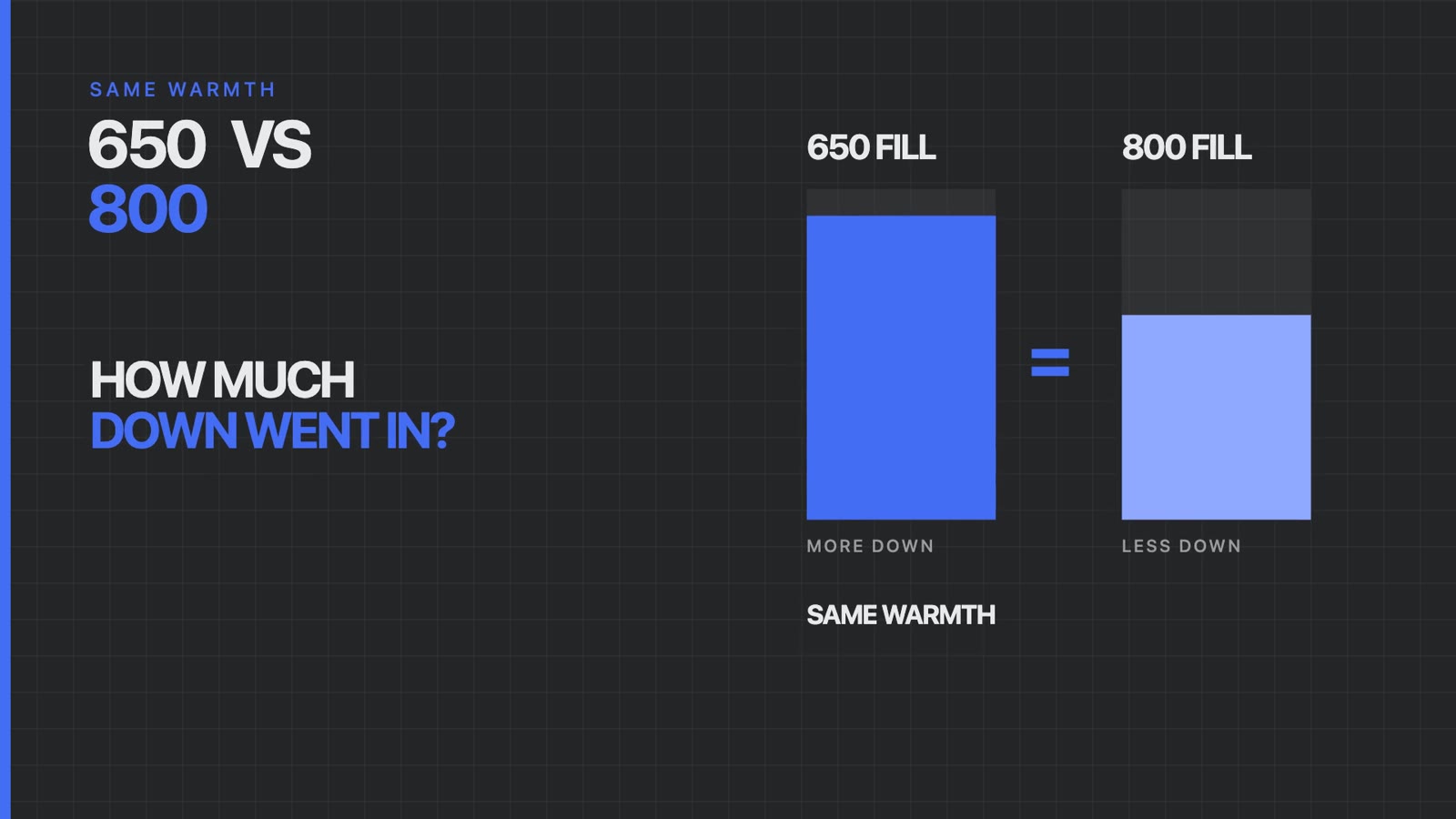
Here's the catch. A higher fill power doesn't automatically mean a better jacket. It means you need less down for the same amount of warmth, so the jacket comes out lighter. With a lower fill power you need more fill to reach the same level of insulation.
Same warmth, different amount of down: a 650 fill power jacket can be just as warm as an 800. It just needs more down in it. So the real question is how much down you want stuffed into the jacket.
In Shadi's experience, if you want a lightweight, packable jacket, you'll want a higher fill power. If you want something puffier, you'll go for a lower fill power, always balancing the thermal insulation you need.
3. The Rain Problem
Moisture is traditional down's biggest weakness, and that's a real problem on a winter jacket that's going to be out in the elements. When down gets wet it clumps up and loses its loft. The loft is what traps your heat in, and wet down takes forever to dry. No loft means no warmth, and none of that puffy, insulating effect.
You can get water resistant treated down. It helps with light moisture, but if the jacket is going to see heavy rain, Shadi says it's still not the way to go.
Synthetic keeps insulating even when it's wet, and it dries very fast.
Adding puffers to your winter collection?
The fill, the ratio, the fill power and where each one sits in the jacket all change the warmth, the weight and the price, so they're worth settling before the first sample.
4. How Long Each One Lasts
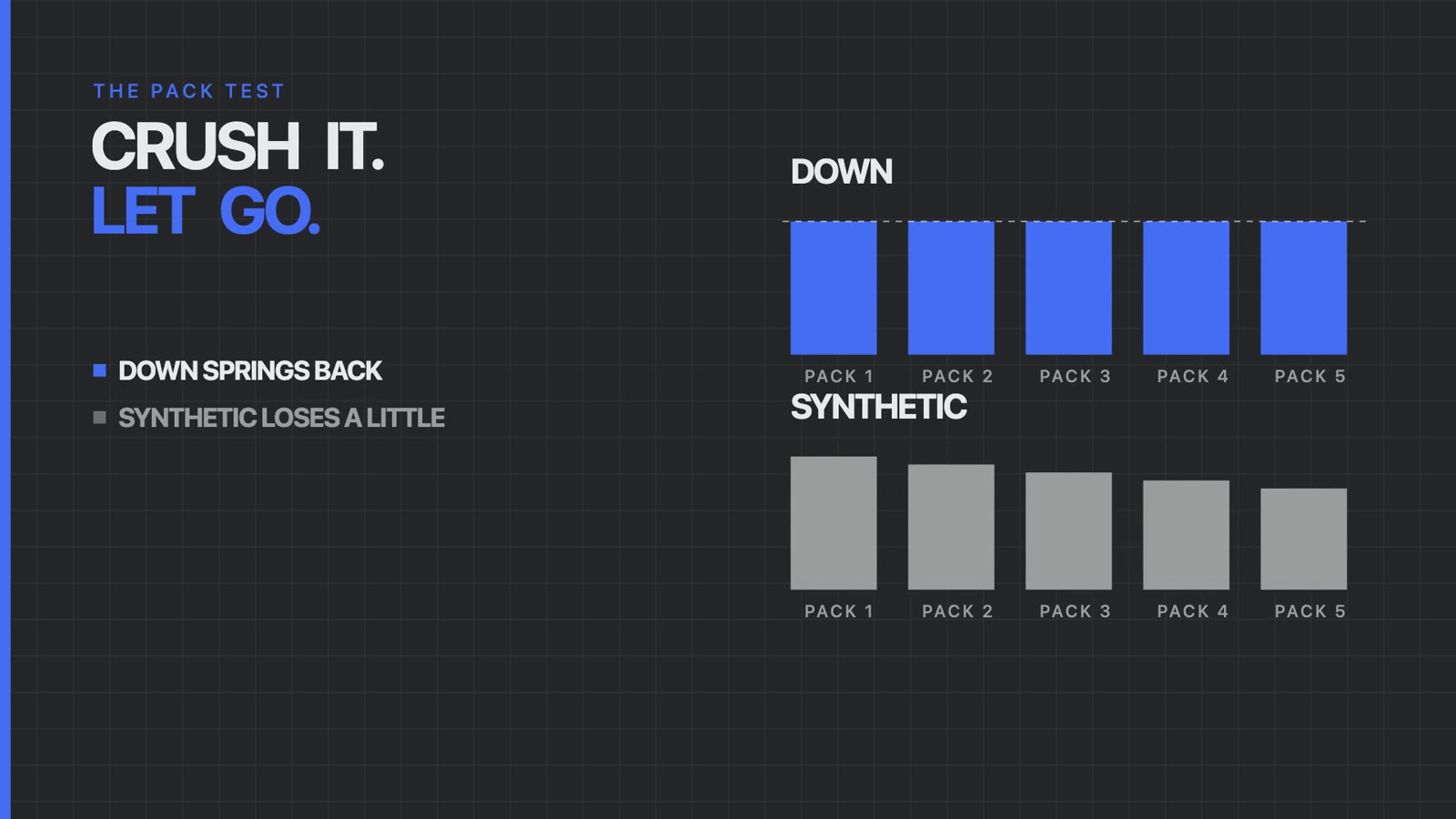
This is where down has the big advantage. If you look after it, down can last for decades. Crush it very small to pack it and it springs straight back to its shape. Shadi had recently packed the vest he wears in the episode into his bag, and it came right back.
Synthetic loses a little of its loft every single time you pack it. The fibers are plastic based, so you're crushing that plastic little by little, and there's no memory to bring it 100% back to its original shape.
Synthetic fibers also come in two kinds:
- Short fiber synthetics are soft and pack really well, but they can shift inside the baffles and leave cold spots.
- Long continuous fibers are more rigid and hold their shape extremely well, but they can feel stiffer and less comfortable than traditional down.
5. Price and Care
On a like for like basis, goose down is the most expensive, duck down is second and synthetic fill is the least expensive. That's not a hard rule though. A goose down with a lower fill power can come in a little cheaper than a duck down with a higher fill power.
- Synthetic costs less, it's way easier to care for and it's hypoallergenic.
- Down costs more, and it needs looking after to give you its longevity over time.
Hybrid jackets
You can also get hybrid jackets. Down goes around the torso, where it won't get direct moisture, and synthetic insulation goes on the shoulders and the top to counter the risk of the fill getting wet. If you're designing a jacket, Shadi says it's something to bear in mind.
The Verdict: Which Puffer Should You Buy?
Shadi's answer depends on the weather you live in and how the jacket gets used:
- Pick down, duck or goose, if you're dealing with cold, dry winters.
- Pick synthetic if the jacket is for the activewear space, where it'll see moisture, rain and sweat, and if you're watching the cost.
It's also give or take. You can mix and match depending on the scenario, your budget and what you're looking for. In the sportswear space you'll see a lot more duck or synthetic, and where you really need a lot of thermal insulation, you'll see goose.
If puffers are going into a winter drop, our guide on choosing between seasonal and evergreen products covers where a seasonal piece fits in your line, and what fleece is and how to use it in sportswear covers another way to build warmth into a collection.

🎬 Watch the full episode. Shadi walks through the baffles, the tag, fill power, the rain problem and the pack test with animations of each one. Watch on YouTube

Full Episode Script
This is the script of the episode as Shadi delivered it, lightly edited for reading.
Two puffers, one tag question
So let's say that you're in a store holding two puffer jackets. Same size, same cut, same shine, same stitching lines. One feels lightweight, but the other feels almost double the actual weight. Which one is colder, and which one will keep you warmer when you're putting it against the elements?
Well, if you've ever looked at a puffer jacket and wondered what 90/10 down versus synthetic filling means, this is going to be the episode for you. Because in the world of puffer jackets, it's the fill that reigns supreme. Do you go for duck down? Do you go for goose down? Or do you go for synthetic? Is synthetic cheap, and should you throw it away? And is goose the king of the hill? Well, the answer is a little bit more complicated than that, and that's exactly what we're going to be discussing on today's episode.
My name is Shadi Adada, and over the last 10 years I've literally helped to spec hundreds of different puffer jackets: sleeveless like the one I'm wearing, full length heavy jackets, full length crop jackets. So I've learned a thing or two about the difference between the different downs and where to spec each.
So if you're a customer looking to pick up your next jacket for winter and you want to make sure that every cent you spend goes where it needs to, or if you're a brand looking to incorporate puffer jackets into a specialist winter collection, this is going to be the episode for you.
1. What's actually inside a puffer
Number one, we have to understand what's actually inside the puffer jacket. A puffer jacket is made out of a layered construction, and there are chambers, called baffles, between stitch and stitch that house the down: either goose, duck or synthetic down.
Down itself isn't just feathers. Down is the layer underneath the feathers on either a goose or a duck that helps to trap heat and insulates the skin of the duck or the goose against the cold. Each cluster of down has thousands of tiny fibers that are phenomenal at trapping heat in.
When you look at down, it has a feather-like appearance, but it's very, very fluffy. It's sort of like if you took feathers, shrunk them down and just took the soft bits out. That's what down is.
Whereas synthetic is polyester based fibers that are clumped together, intended to simulate the effect of down. Basically, they're fine fibers that are built to look and to act like down. And in each of the baffles, you can either put feathers, or you can put the down itself, or you can put the synthetic insulation.
What 90/10 means
So to understand the 90/10 or 80/20 structure, what we have to understand is that the first number in that combination is the down. It's the clusters, and that is a percentage. So of the total volume, 90% in the 90/10 is the clusters, and 10% of that is the feathers.
2. What fill power means
Number two, you've obviously heard of fill. You might see 90/10, 650 fill. The fill itself isn't the actual size. It's the warmth rating of the fiber. So fill power isn't just about how much space the down fills. It specifically means that 700 fill power will allow one ounce of that specific down to fill up 700 cubic inches of space.
Feathers typically sit around 300, the best goose down can go all the way up to 900, and with duck it ranges between 750 to 800.
So here's the catch. A higher fill power doesn't necessarily mean that you're getting a superior product. It just means that you need less down for the same amount of warmth, so it's going to be lighter, on a case by case basis, than something that has a lower fill power. With a lower fill power, you'll need more of that fill to allow for the same level of insulation. So 650 fill power can be just as warm as an 800, but you just need more of it.
So the question here is not necessarily what's the fill power. It's how much down do you want stuffed into your jacket. If you want a more lightweight, packable jacket like this, you're going to want to go for a fill power that's higher. If you want something that's a bit more puffy, then you're going to want to go for a lower fill power, obviously balancing the desired thermal insulation.
3. The rain problem
Number three comes down to moisture, or rain, which is traditional down's biggest weakness. This is a big problem, because obviously with a winter jacket you're going to be exposing it to the elements.
But for traditional down, the wet causes the down to clump up, which means it loses its loft. It's the loft that allows for heat to be trapped in, and it takes forever to dry. So no loft means that you're not gonna get the warmth effect, and you're just not going to get that nice puffy effect that is thermal insulating and allows your heat to be trapped in.
You could also have water resistant down, or water resistant treated down. This helps with light moisture, but if you're going to be exposing it to heavy, heavy rain, it's still not going to be the way to go. Synthetic is going to keep insulating and keep doing its thing even when it's wet, and it dries very, very fast.
4. How long it lasts
Number four. So when it comes to durability, how long does down last versus synthetic? This is the big advantage of down: if you look after it, it can last for decades. And if you crush it very, very small, if you pack it up, and I know this because I just recently packed this into my bag, it will immediately return back to its shape. So it's really good at remembering what its shape is.
With synthetic, it loses a little bit of its loft every single time that you pack it, just because of the way that the fibers are. They're plastic based, so you're crushing that plastic little by little, and there's no memory that allows it to go back to its original shape 100%.
So what you want to do is make sure that you have a nice mix. When you want to go for thermal insulation, then down is great. When you want to go for durability, then polyester, or synthetic insulation, is going to be great.
And when it comes to synthetic insulation, your soft short fiber synthetics pack really, really well, but they can shift inside the baffles readily, which just leaves cold spots. And long continuous fibers are very rigid and hold their shape extremely well, but they can just feel a little bit more stiff, and it can be a little bit more uncomfortable, especially when you're comparing it to traditional down.
5. Price and care
Number five is the price. When it comes to price, goose down is the most expensive, duck down is the second most expensive, and then synthetic fill is going to be the least expensive.
Now obviously, if you have a goose down with a lower fill power, it might be a little bit cheaper than a duck down with a higher fill power. So it's not that all goose down is going to be more expensive than duck down, but in general, on a like for like basis, goose down is going to be the most expensive, with duck down being the second and synthetic being the third.
Synthetic costs less, but it's way easier to care for, and it's hypoallergenic. Whereas duck down or goose down costs more, and you also have to take care of it to get its longevity over time.
And you can also get garments that have hybrids, where you have the down in areas around the torso where you're not going to get direct moisture, and then on the shoulders, on the top, you're going to get thermally insulated synthetic insulation to counteract the risk of the insulation getting wet. So if you're designing a jacket, bear this in mind.
The verdict
So what is my verdict here? Well, if you are designing for cold, dry winters, then down, duck down or goose down, is going to be great. If you are going to be using this in the activewear space, where it's going to be exposed to moisture, rain and sweat, and you're very conscious of the cost, then go for synthetic.
And it's a give or take. You can almost mix and match, so it depends on the scenario and your budget and what you're looking for. In the sportswear space, you're going to see a lot more duck or synthetic. In the fashion space, and in the areas where you really need a lot of thermal insulation, you're going to see goose. That's where Canada Goose gets its name.
Work with us 1-on-1
So if you guys enjoyed this episode and you're looking to develop your next line of puffer activewear or jackets, you can check out the link in the description to apply to work with us one-on-one. Within five minutes, a real human will get back to you with a personalized production roadmap on how we can help you take your idea and turn it into a physical sample in under 30 days, and also how we can take you all the way through low minimum order quantity batch production.
Guys, I say this from the very bottom of my heart, thank you so much for tuning in to this episode of FittDesign TV. Until next week's episode, stay awesome.
About FittDesign
FittDesign is the world's first sportswear design agency. Over the last 10 years the team has helped thousands of brands design, develop and produce quality activewear that represents their brand and their vision, from the first sketch and tech pack through sampling and bulk production.
Ready to build your winter collection?
Tell us what you're making and a real human will get back to you with a personalized production roadmap. From your idea to a physical sample in under 30 days.
Get a quote → Takes 2 minutes. No obligation.