

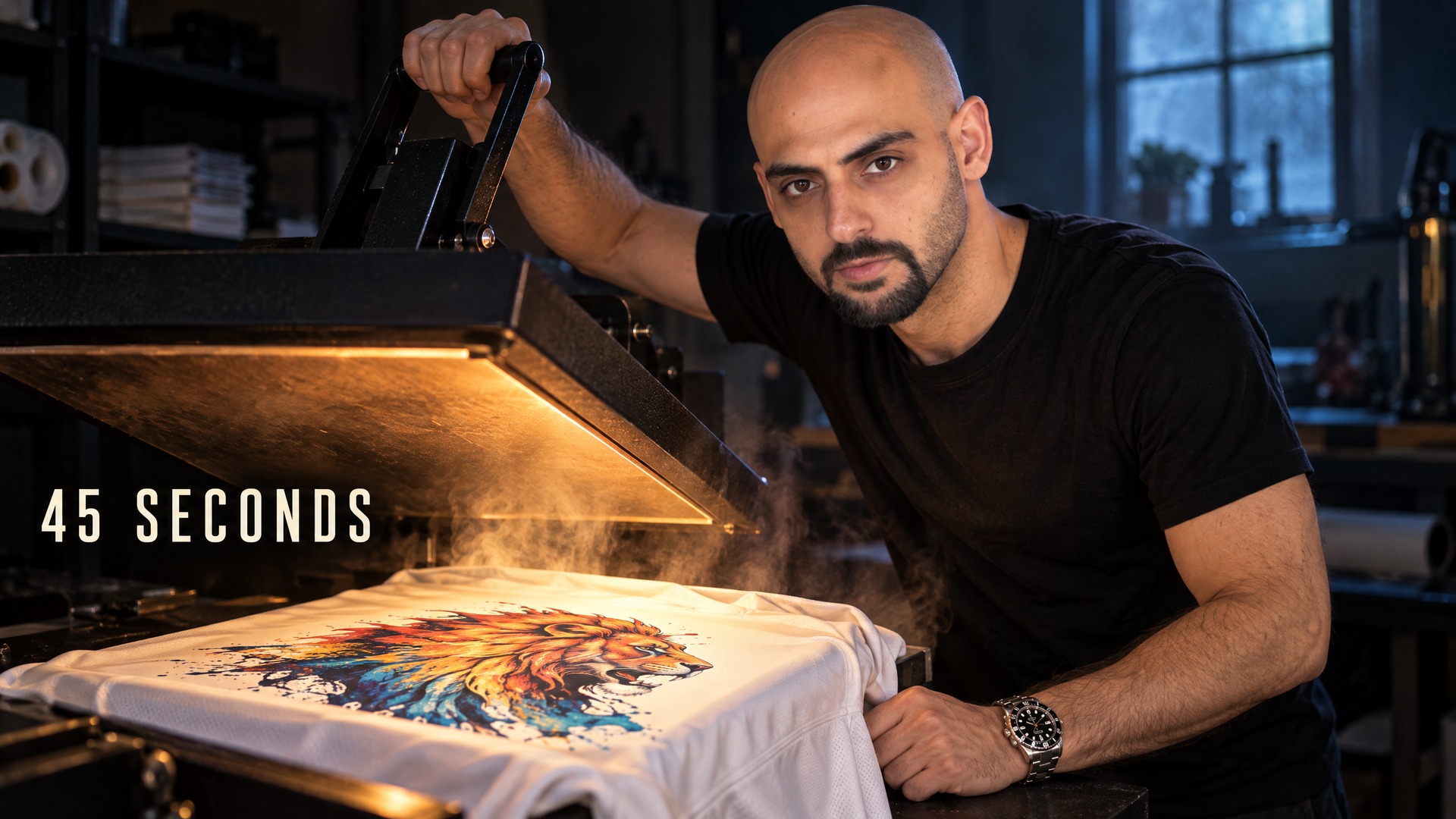
You've probably got a gym top or a pair of leggings with a print you can't feel. Run your hand over it and there's no edge, no thickness and nothing to catch. Stretch it and it doesn't crack. That print was never a liquid when it went onto the garment. It started as a gas.
That's sublimation printing, and Shadi Adada, co-founder and creative director of FittDesign, has spent the last 10 years working with over a thousand sportswear brands on every kind of printed garment. In his experience, for one very specific type of garment, sublimation is the best option you can go for. For a lot of other garments it simply won't work, and the reason why is decided before anybody turns a machine on.
The short answer: sublimation turns the dye into a gas that goes inside polyester fibers, so the color becomes part of the fabric instead of sitting on top of it. It's the right call for all-over prints on polyester performance wear, it won't work on cotton, and the seam allowance and color approval need to be written into your tech pack before the first sample.
Prefer to watch? The full episode is embedded at the bottom of this post, along with the complete script.
1. What Is Actually Happening
Sublimation is a word from chemistry. It describes a solid that turns straight into a gas without ever going through a liquid phase. If you've ever watched dry ice smoke, that's the same kind of process.
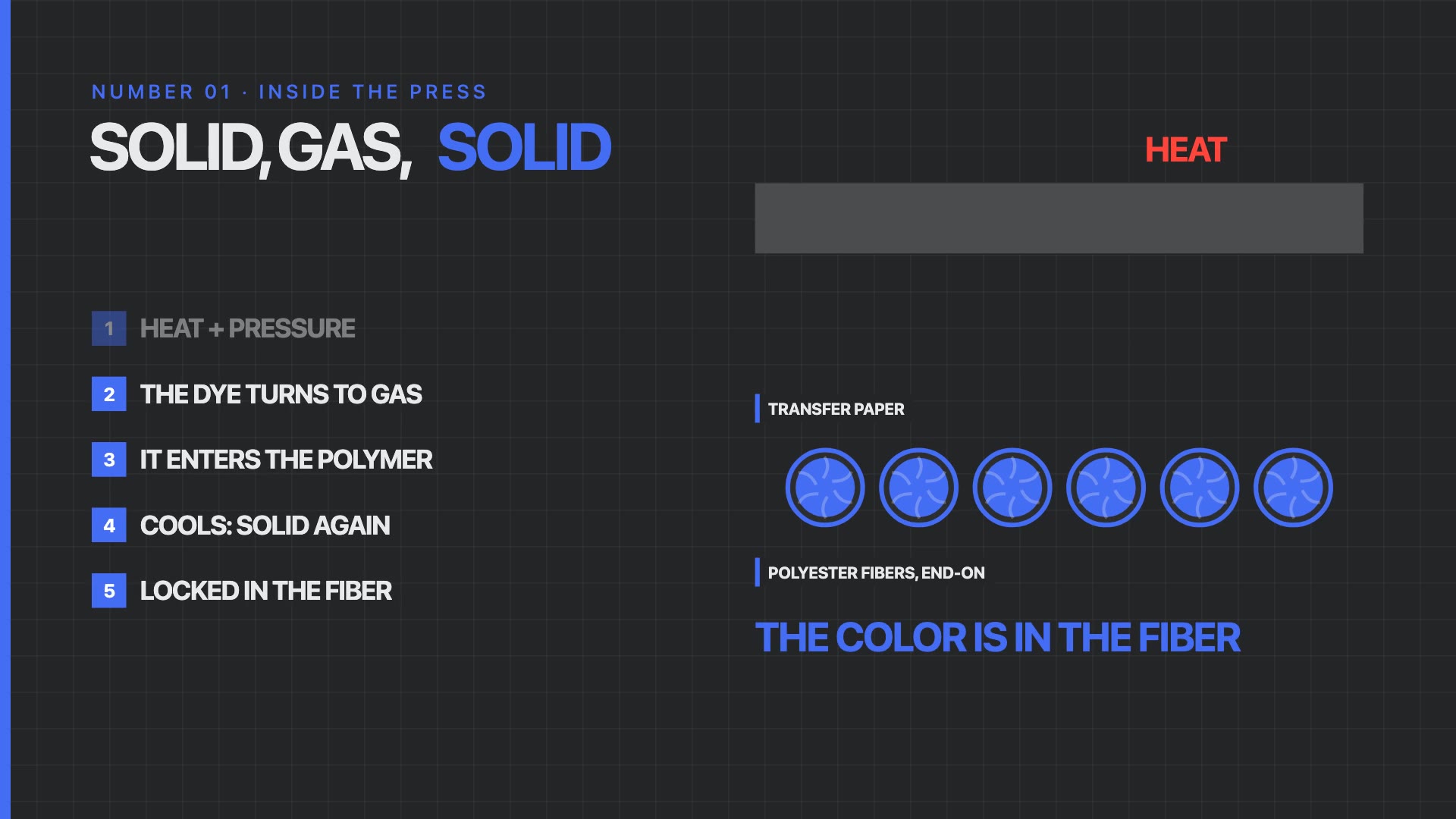
The dye starts as a printed image on sublimation transfer paper. It's a disperse dye, the same type of dye that's used to color polyester fibers at the mill.
Here's what happens inside the press:
- Heat and pressure come down on the paper and the fabric.
- The dye on the paper turns into a gas.
- The gas moves into the polymers in the polyester fibers.
- When it cools down, the dye goes solid again, inside the fiber.
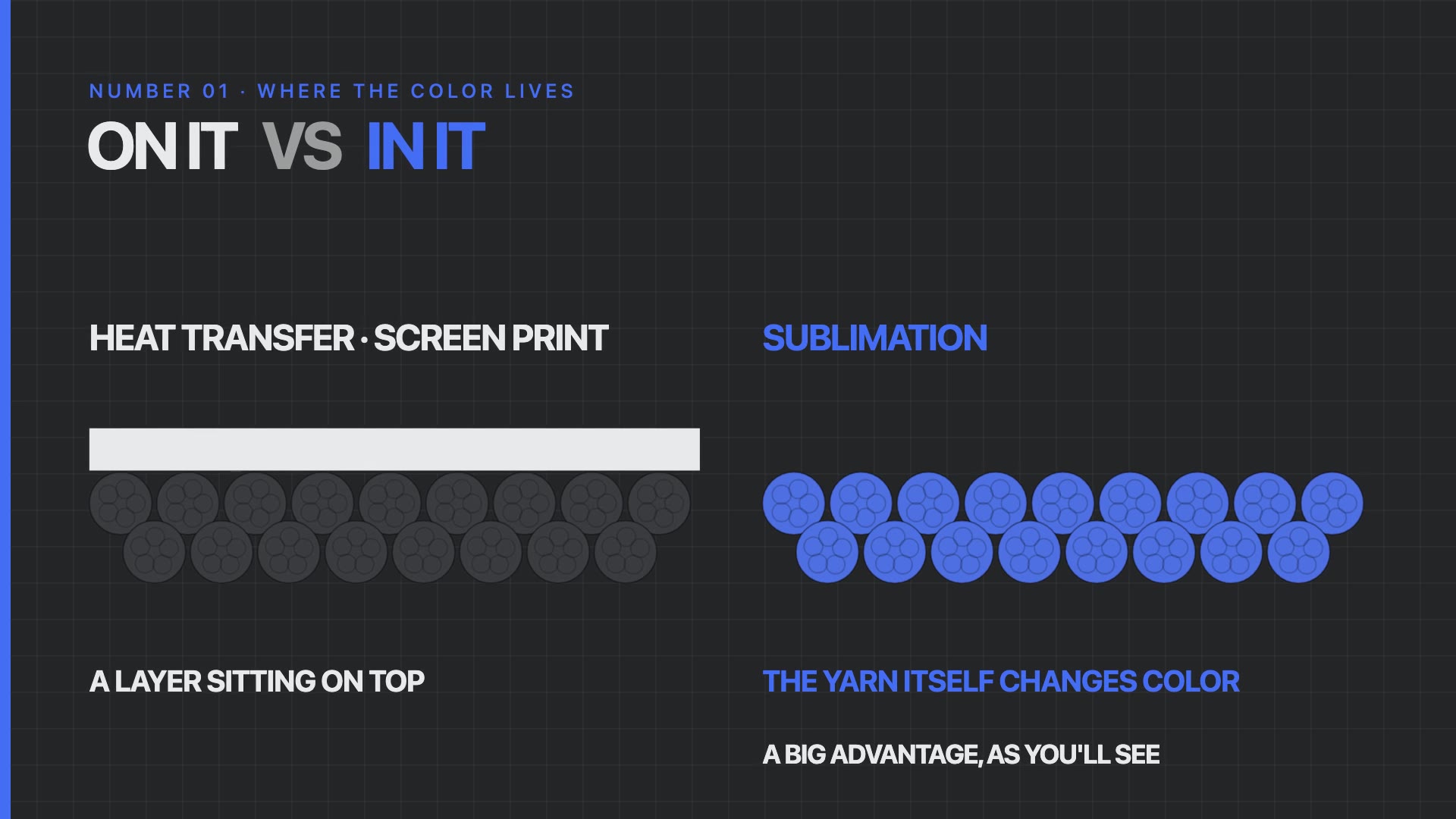
So the color doesn't sit on top of the fabric the way a heat transfer or a screen print does. It sits within the fiber itself, and that's the big advantage you'll see in the rest of this post.
2. The Numbers on the Machine
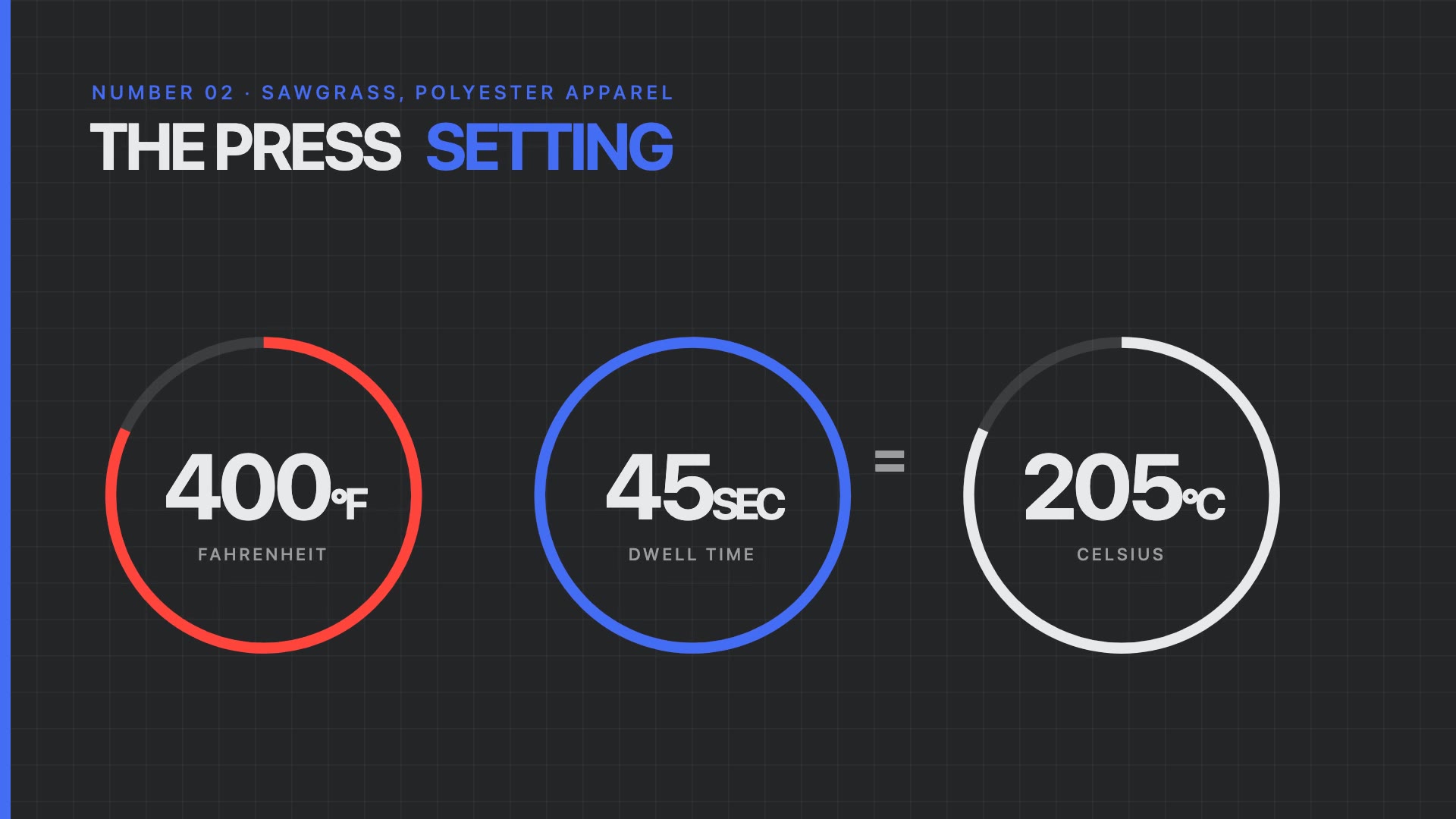
Sublimation needs a specific type of machine and a specific application method. Sawgrass, one of the biggest makers of sublimation inks, puts polyester apparel at around 400°F for 45 seconds, which is around 205°C.
Hard substrates are a different story. A mug or a phone case might run anywhere between 180 and 205°C, and it can need a dwell of around seven minutes, otherwise the ink comes out faded or doesn't bond properly.
Spec tip: the press settings depend on the fiber or material you're printing onto, not on the design. Polyester apparel and a mug need very different numbers.
If you get the dwell wrong, one of two things happens:
- Too short: too little ink ends up in the fiber, so the color looks faded and not as strong.
- Too long: you can scorch the polyester, and the surface of the fabric starts to turn yellow.
3. Why It Won't Go on Cotton
This is the question Shadi gets all the time. Why can't you put a tie dye, an army camo or a picture of the Mona Lisa on your favorite cotton tee with sublimation?
The gas needs a polymer to enter, and polymers are pretty much only found in synthetic fibers like polyester. Cotton is a cellulosic fiber, so there's nothing for the dye to go into.
On a cotton tee, the dye lands on the surface of the fabric instead of inside it. It might look good coming off the press, but as soon as you wash it, the ink fades away and washes out.
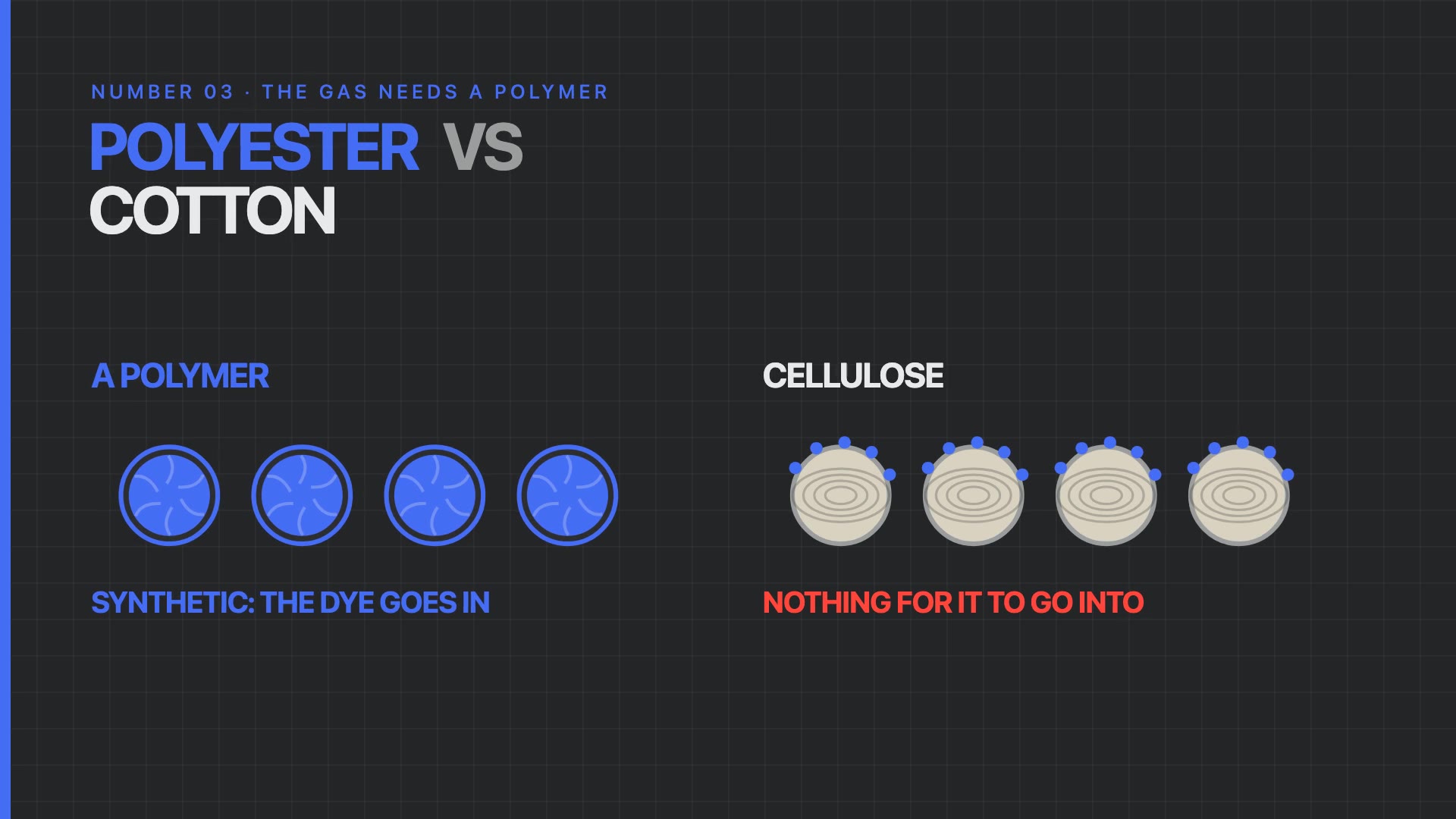
That's why this matters so much. The fabric you choose decides whether sublimation is even possible, before the print method ever comes into it.
Choosing a print method for a performance line?
The fabric, the print method and where every graphic sits all need to be settled before the first sample is made.
4. What You Actually Get With It
Given how strict the rules are on fabric, here's why brands still choose sublimation:
- No ink layer at all. Nothing sits on top of the fiber, so there's nothing to fade out, stretch out or crack.
- The panel still breathes. Because the ink is inside the fiber, the knit can still stretch and breathe. That matters a lot on compression garments that sit close to the skin. A fully enclosed plastisol layer doesn't let the fibers breathe or stretch in the same way.
- It runs edge to edge. You can print all-over graphics panel to panel, even from the sleeve onto the torso, in a cost efficient way. With screen printing that's economically unfeasible. It's why you see sublimation on MMA rash guards and on cycling, soccer and football team kits.
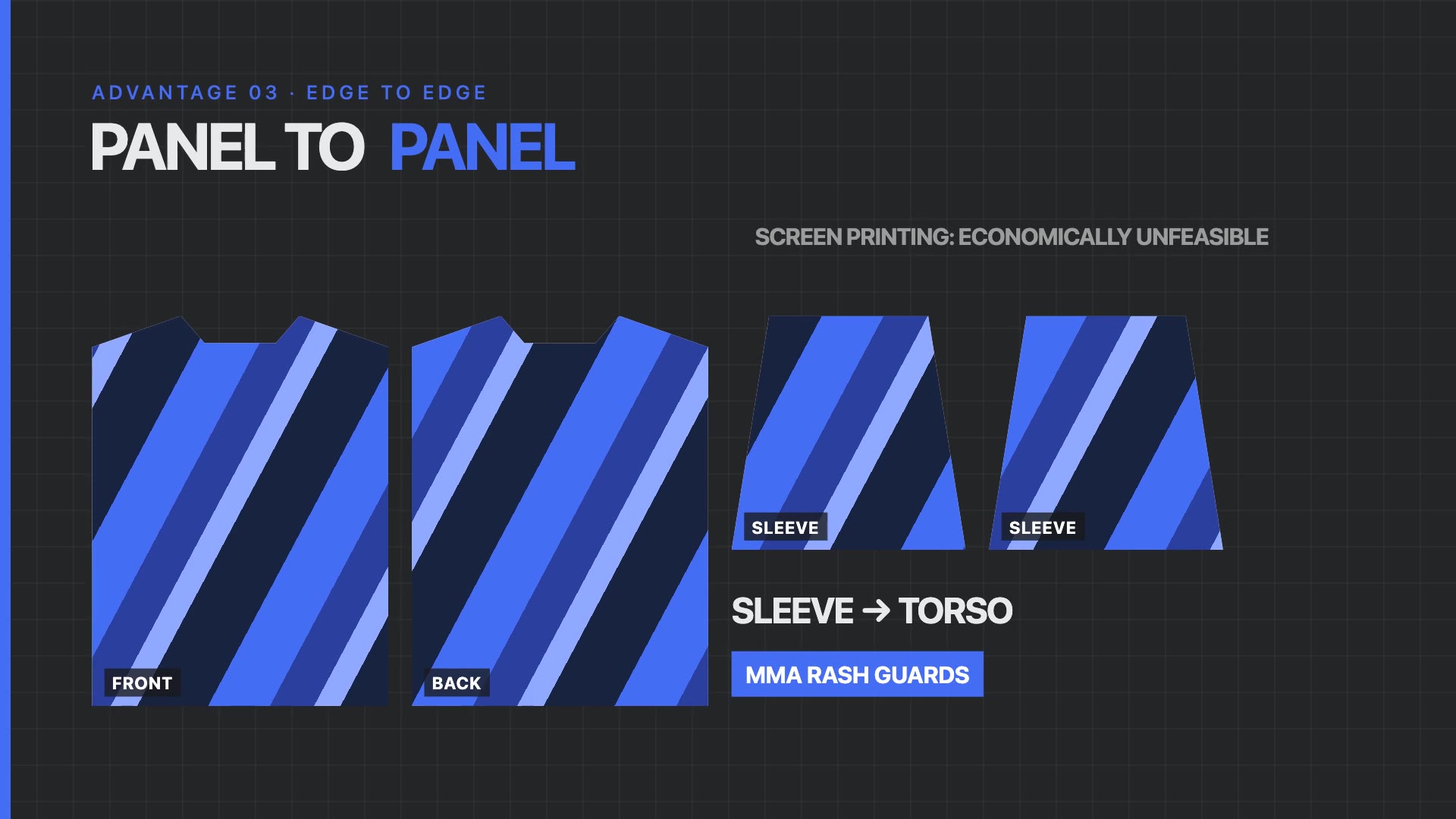
The trade off is real, though. You're locked into polyester, and you're locked into light base fabrics, typically white. That's where the white inside of a sublimated garment comes from when you turn it inside out. You can do a double sided print, but you'll pay more, and you can't print on dark colors like black. A white stripe on a black base isn't possible.
5. The Two Failures Shadi Sees Most
The white line in the seam. Take a sublimated tee, stretch out the side seam, and you'll often find a pure white line hiding in the crease, or a section that looks faded. It happens because the artwork files and cutting patterns don't leave extra room for the seam allowance or the bleed. The print stops at the cut line, and once the fabric is sewn and stretched, the unprinted edge shows.
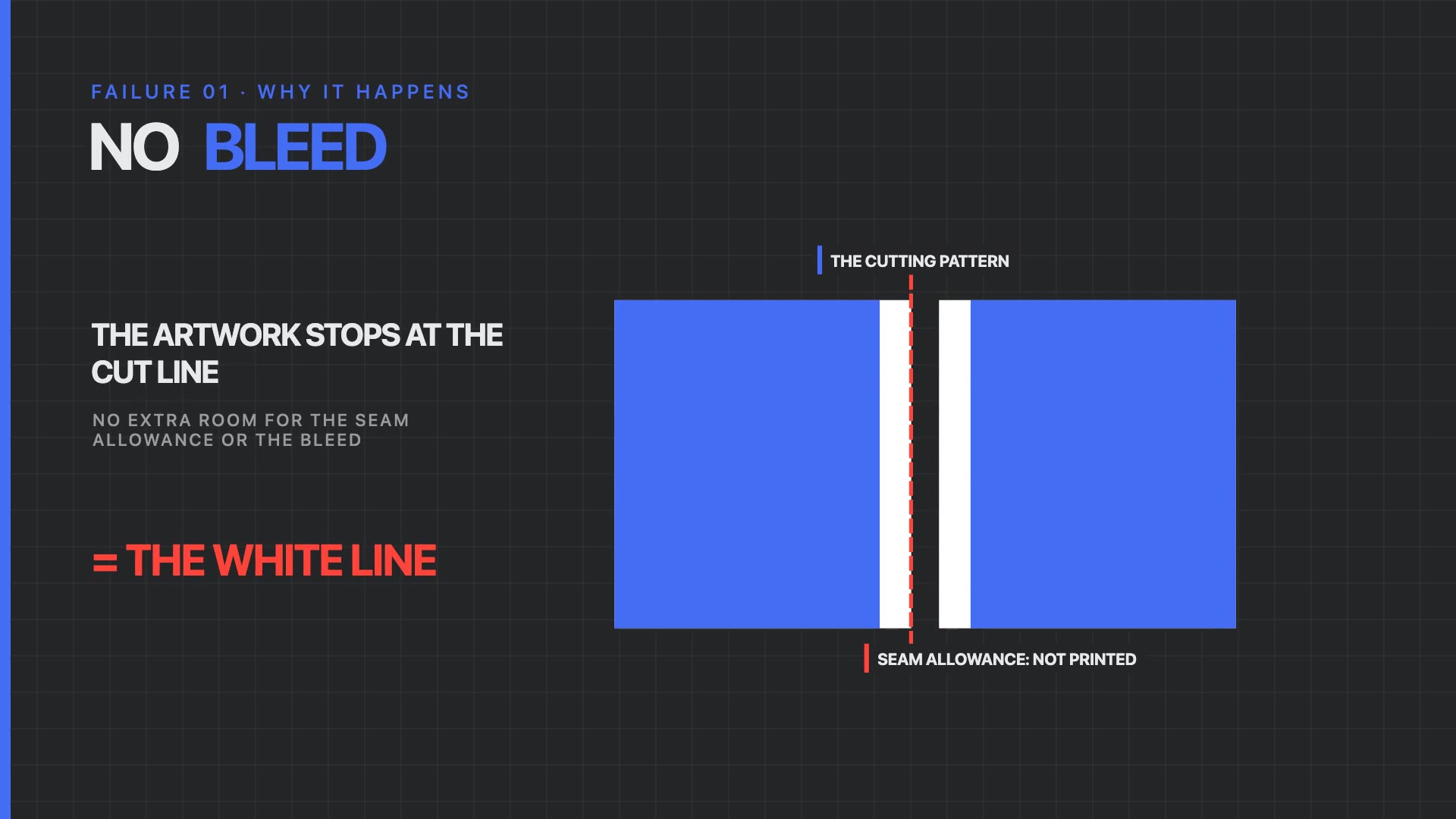
Shadi's recommendation is to build the seam allowance into the artwork files. That way there's no stripe after cutting, and every cut piece that goes in is fully printed with no faded edges.
The color that came back wrong. Sublimation printing uses an ICC color profile, but depending on the screen you're looking at, you might not be seeing the color in a true, profile compliant way. What you see on screen can be a little different from what you get in real life. Shadi suggests using an accurate screen like an iPhone or a MacBook, and always getting a physical swatch before the final sign off for bulk.
The Verdict
If you're making all-over prints on performance garments where stretch, durability and moisture wicking are key, sublimation is the way to go. If you're after a more natural feel and an all-over print isn't essential, a screen print may be the better fit.
Just keep the trade offs in mind:
- You're limited in the fibers you can use.
- You're limited in the base colors you can print on.
- Production happens one piece at a time, so at really large quantities, in the 1,000 to 5,000 plus range, it can cost more than buying fabric that's already printed on the roll and cutting the patterns from it. For a startup brand, that usually isn't a big issue.
If you're still comparing print methods, Shadi also breaks down DTF vs screen printing and plastisol vs water-based ink for cotton tees.
🎬 Watch the full episode. Shadi walks through the press, the cotton problem and both failures with full-screen animations: https://www.youtube.com/watch?v=Gbg49zzcHHg

Full Episode Script
This is the script of the episode as Shadi delivered it, lightly edited for reading.
Intro
So I have a riddle for you. This type of print that's on your favorite gym shirt or pair of leggings was never a liquid when it was applied as a print on the garment. It started off as a gas, and it made its way onto the garment without ever having to become a liquid. What is it exactly?
At the same time, when you rub your hand over the print, you'll never find the texture, you'll never feel its thickness, and you'll never be able to snag or catch the edge of it. And when you stretch it, it won't crack, it won't fade, and you'll be able to print any color in the spectrum that you want. What print is this?
And if you guessed that it was a print on your favorite cotton t-shirt, you'd be wrong, because this print can make or break a garment before it even gets applied. And for 50% of the garments that you see in the activewear market, this type of print isn't possible.
Well, what is that print? That's exactly what we're going to be talking about in today's episode. It's sublimation printing.
My name is Shadi Adada, and over the last 10 years I've had the privilege of working with over a thousand sportswear brands on all forms of printed garments. What I've learned is that, consistently, for a very specific type of garment, sublimation printing is going to be the most elite option you can go for. Why is this? Well, that's exactly what we're going to be discussing on today's episode.
1. What is actually happening
Number one, we have to understand what sublimation printing is and what's actually happening. Sublimation is a word from chemistry, and it's the idea of a solid turning straight into a gas without going through the liquid phase. If you think of it like dry ice, this is exactly that kind of process.
The dye actually starts as a printed image on sublimation paper, and it uses a disperse dye, which is the same type of dye that's used to apply color onto polyester fibers. It's the heat and the pressure that turn this into a gas, which then transfers onto the polymers in the polyester fibers. When it cools down, it goes solid again, and that's what allows it to bond to the fiber.
So the color doesn't sit on top of the fabric like a heat transfer print or a screen print. It sits within the fiber itself, which is a big advantage, as we'll see in later parts of this episode.
2. The numbers on the machine
Number two is that there are very specific types of machines and a specific application method required to apply sublimation printing properly. Sawgrass, which is one of the biggest makers of sublimation inks, puts polyester at around 400 degrees Fahrenheit for 45 seconds, which is around 205 Celsius.
For a hard substrate like a mug or a phone case, you might need to do it between 180 and 205, and you'd need to let it dwell for around seven minutes, or else the ink can come out very faded or just won't bond correctly. So the pressure, the time and the dwell have nothing to do with the print you're applying. It's more about what type of fiber or material you end up applying it on.
If you get the dwell wrong, one of two things can happen. If the dwell is too short, the amount of ink that ends up on the finished fiber is too little, which makes the color very faded and not as strong. But if you overdo it, you can end up scorching the fiber, which can yellow the surface of the fabric, and that's also not what you want.
3. Why it won't go on cotton
Number three. So you might be asking, "Shadi, okay, sublimation sounds lovely, but why can't I put it onto my favorite cotton t-shirt? I'd love to have a cotton t-shirt with a beautiful tie dye or army camo or the picture of the Mona Lisa on it. Why can't I put it on cotton?"
What we have to understand is that the gas needs a polymer to enter, and polymers are pretty much only found in synthetic fibers like polyester. Cotton is a cellulosic fiber, so there's nothing for the dye to actually go into and transfer onto.
So on a cotton t-shirt, the dye ends up landing on the surface of the fabric as opposed to inside the fabric. That might look good once it's off the sublimation press, but as soon as you wash it, the ink fades away and washes out. That's not what you want, and it's essential to understand, because it means it's not the print or the method. It's the fabric you choose that dictates whether sublimation is even possible.
4. What you actually get
Number four. So what are the actual advantages of sublimation? Given its very specific rule set for what types of fabric can be used, why is this something you'd even want to concern yourself with?
Well, number one is that there's no ink layer at all. There's no ink sitting on top of the fiber, so there's nothing to fade out, nothing to stretch out and nothing to crack, which is a major plus.
The second thing is that on sportswear fibers, the ink sitting inside the fiber allows the panel to breathe. That makes it very useful for compression garments that sit close to the skin, where the knit needs to stretch out and stay breathable. If you're using a totally enclosed plastisol ink, you wouldn't allow those fibers to breathe or even stretch.
Three is that a sublimation print can easily run edge to edge in a very cost efficient way, which is economically unfeasible with screen printing. You can create all-over prints that go from panel to panel, maybe from the sleeve to the torso, which is exceptionally useful on things like MMA rash guards and other all-over printed garments. And that's why you tend to see teams with all-over prints, like cycling teams, soccer teams and football teams, use these prints, because they allow very unique designs that wouldn't be possible with traditional screen printing.
So what's the trade off here? Well, you're ultimately locked into polyester, because you need polyester to take the ink and bond it to the polymer. And you're also locked into lighter base fabrics. You typically have to print on white, and that's where sublimation gets its characteristic white inner layer when you turn it inside out. The solution for this is a double sided print, but of course you end up paying more, and you can't print on darker colors like black. It's impossible to print a white stripe on a black base.
5. The two failures I see most
Number five. As a designer and a producer, what are the main failures I see most with sublimation printing, and what should you avoid if you're looking to bring it into your garments?
It comes down to the white line in the seam. If you take a sublimation printed t-shirt and look at the side seam, for example a plain seam, and you stretch out that seam, you'll always find a section between panel and panel where there's either a pure white line hidden in the crease of the seam, or it's more faded.
The reason is that when a lot of designers or factories create the artwork files and the cutting patterns for the torso piece, they don't allow a lot of extra room for the seam allowance or the bleed. They basically just create the seam allowance and print on it, and then once you start stretching out the fabric, it causes those issues, especially if you're using a flat seam.
So my recommendation would be to make sure you include your seam allowance in the artwork files. That way there's no stripe after it's cut, and your cut piece goes in completely printed, with no faded edges at all.
Some of the other issues I see is that the color comes back wrong. Sublimation printing uses an ICC profile, or a color profile, but you do need to physically see a sublimation swatch before you approve it for bulk. Depending on what screen you're on, you might not be seeing it in a true ICC profile compliant way, and what you see on your screen might be a little different from what you get in real life. So my recommendation would be to use an iPhone or a MacBook, which tend to have very accurate screens, and of course get a physical swatch before the final sign off.
The verdict
So what's my verdict here? Well, if you're going for all-over prints on performance garments where stretch, durability and moisture wicking are key, then sublimation is going to be the way to go. If you're looking for more of a natural feel and an all-over print isn't essential, perhaps you can get away with a screen print, and that's where you need to go.
But consider that the trade off for using sublimation is real. You're limited in terms of fibers, you're limited in terms of the color bases you can print on, and ultimately you're also limited in production scalability, because sublimation printing happens one piece at a time. That's a little more inefficient than getting a roll of fabric that's pre-dyed or pre-printed and then cutting the patterns from it.
So for really large quantities, sublimation printing can actually be a little more expensive from a unit economics point of view than getting fabric that's pre-printed with an all-over print and cut from that. That's usually an issue for manufacturers or brands going into the 1,000, 5,000 plus range. If you're a startup brand, this may not be a huge issue for you.
Work with us 1-on-1
Well guys, that is it. That's a wrap on this episode. If you've been looking to get into sublimation printing, you're looking to release your own range of all-over printed garments for your performance apparel line, and you want to set up the print and make sure you're selecting the right fabric for the best possible sublimation result without sacrificing any of the comfort, the look and the quality, you can check out the link in the description to apply to work with us one-on-one. Within five minutes, a real human will get back to you with a personalized production roadmap on how we can help you take your idea and get a physical sample in your hands in under 30 days.
And guys, I say this from the very bottom of my heart, thank you so much for tuning in to this episode of FittDesign TV. Until next week's episode, stay awesome.
About FittDesign
FittDesign helps sportswear and activewear brands go from an idea to a physical product, with factory-ready tech packs, sampling and production support. Over the last 10 years the team has worked with over a thousand sportswear brands.
Ready to build your all-over printed range?
Tell us what you're making and we'll come back with a personalized production roadmap. A real person gets back to you within five minutes.
Get a quote → Takes 2 minutes. No obligation.


