

Packaging slip-ups rarely stay contained. One off-spec flap can snowball into downtime, freight surcharges, shortened shelf life, and higher EPR fees. Little wonder 42 percent of brands in Packaging World's 2026 contract packaging survey plan to increase external manufacturing and packaging over the next two to three years, with access to specialized equipment as the top driver. After reviewing hundreds of vendor pages and case studies, we pinpointed five service models that give you the right engineering horsepower for your next launch.
Quick answer, who tops the list and why
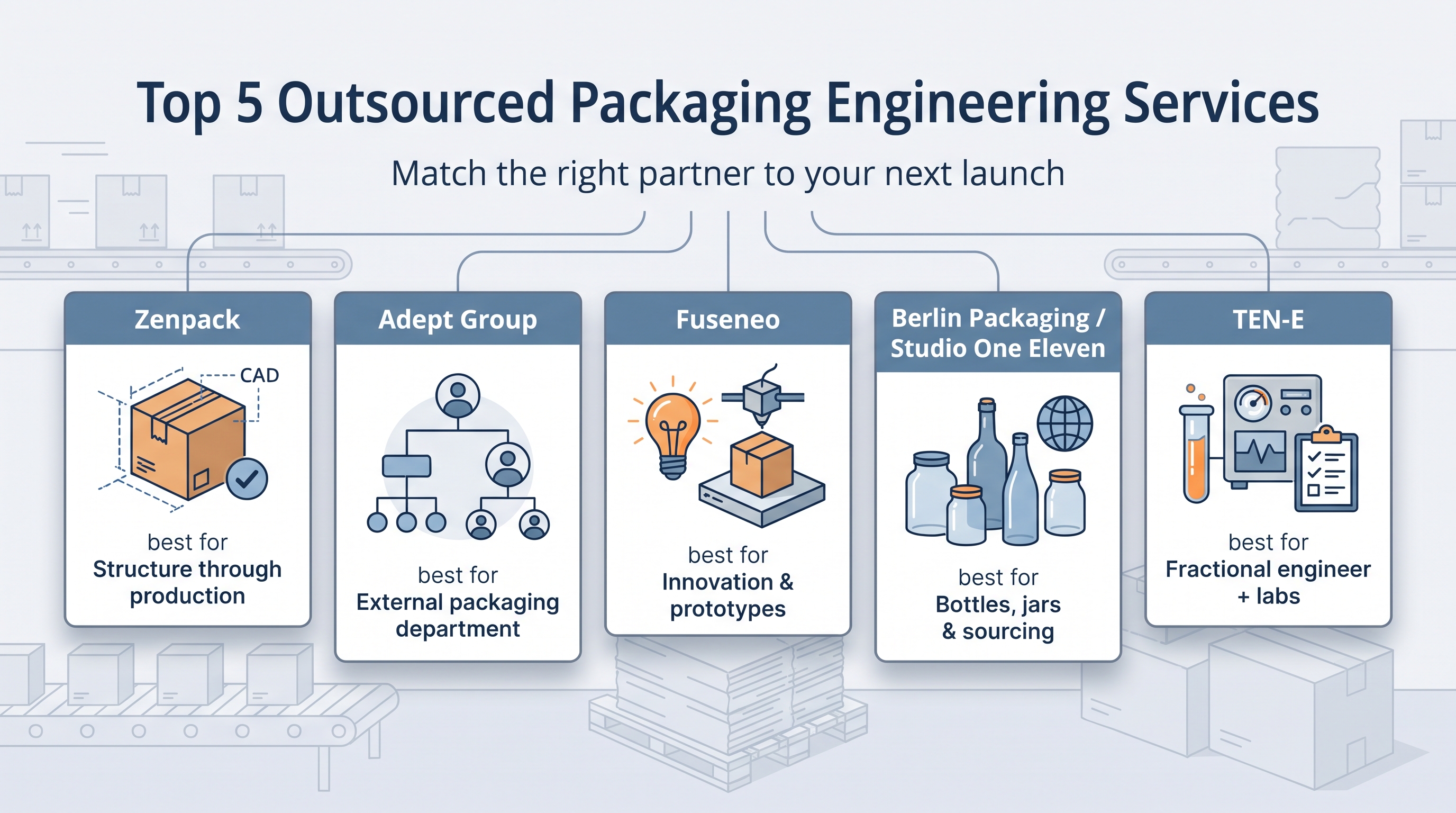
Zenpack: integrated partner that oversees structure, prototyping, and production with one accountable team.
Adept Group: outsourced packaging department that spans EPR strategy through line qualification.
Fuseneo: rapid-iteration studio for high-fidelity prototypes and Amazon SIPP optimisation.
Berlin Packaging / Studio One Eleven: go-to for bottles, jars, and closures when you want design plus global sourcing.
TEN-E: fractional-engineering model that pairs monthly expert support with accredited lab testing.
We scored each provider against seven real-world factors so you can match their strengths to your own packaging puzzle.
How we ranked the providers
Inclusion rules
A firm had to clear four hurdles:
Real engineering. Structural or material work (CAD, test protocols, material specs), not just graphics.
Commercialisation support. Ability to deliver production-ready specs or stay involved through tooling, line trials, or sourcing.
SMB accessibility. Willing to work with small or midsize CPG brands via projects, retainers, or fractional models.
Verifiable proof. Accredited labs, quantified case studies, engineering awards, or third-party reviews.
Only five providers met every requirement.
The seven-factor scorecard
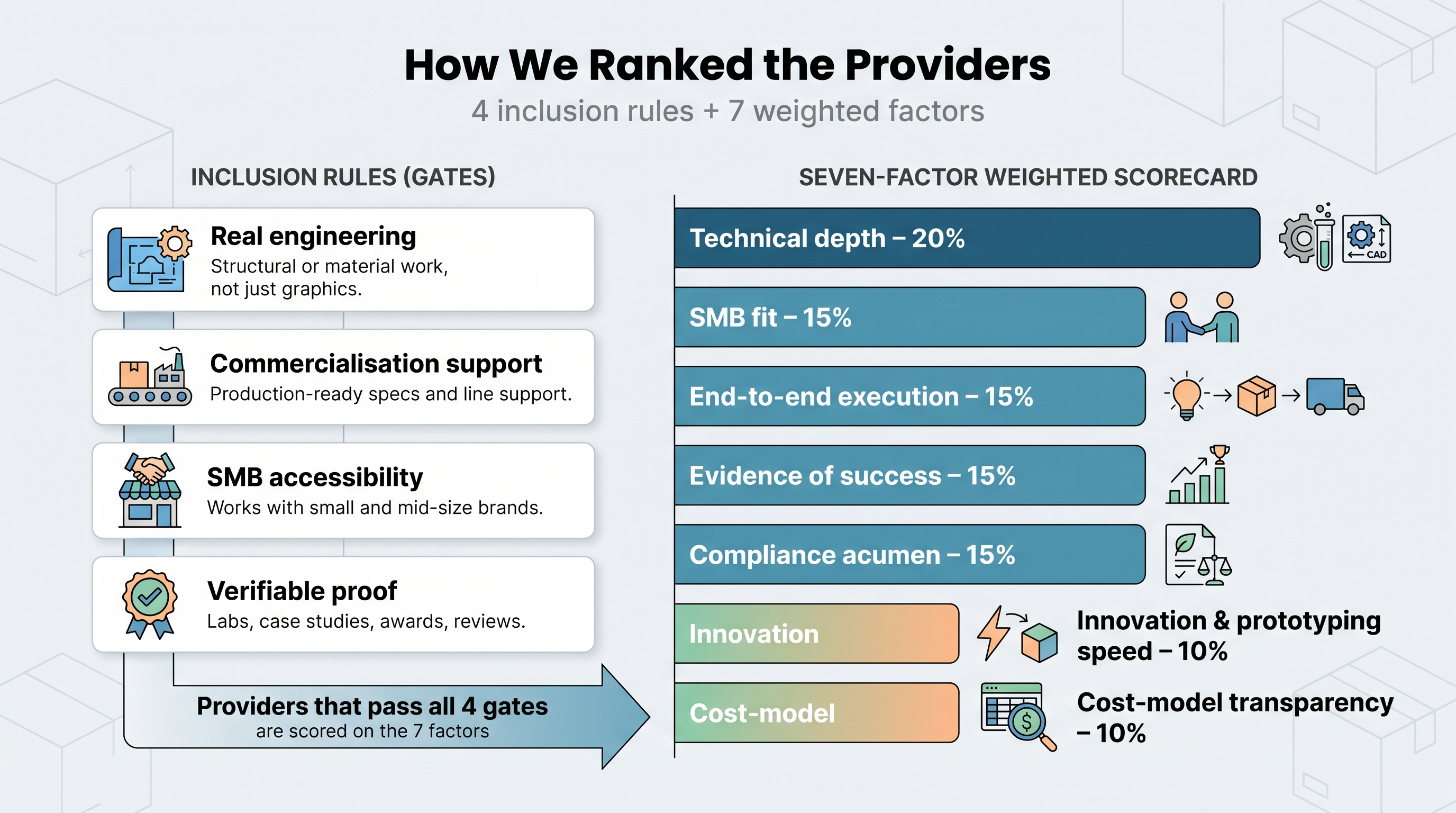
Those five providers earned weighted scores across seven factors:
| Factor | Weight |
|---|---|
| Technical depth | 20 percent |
| SMB fit | 15 percent |
| End-to-end execution | 15 percent |
| Evidence of success | 15 percent |
| Compliance acumen (sustainability + regulation) | 15 percent |
| Innovation and prototyping speed | 10 percent |
| Cost-model transparency | 10 percent |
This mix favors operators that can turn concepts into compliant, test-proven packaging, not pure creatives. The next section shows how the numbers stack up.
Side-by-side comparison
Scan the grid below to see how the five finalists stack up on the factors that matter most.
| Provider | Best for | Engagement model | In-house testing | Manufacturing-sourcing role | Public pricing signal* | Main watch-out |
|---|---|---|---|---|---|---|
| Zenpack | One accountable partner from concept to production | Project fees | ISTA lab | Integrated production available | Scoped per project | Share launch dates early so prototype rounds fit the tooling schedule |
| Adept Group | Outsourced packaging department, EPR help | Consulting, staffing, managed teams | Line qualification support | Coordinates suppliers, not a converter | Price on request | May exceed the needs of a single-SKU start-up |
| Fuseneo | Innovation, prototypes, Amazon SIPP | Project or production-linked | On-site test lab | Optional through Fuseneo | Design cost rolled into supply | Clarify design portability if you change manufacturers |
| Berlin Packaging / Studio One Eleven | Bottles, jars, closures, global reach | Design fee waived with supply deal | Prototype and validation lab | Extensive global factory network | “Free” design tied to qualified volume | Scrutinise tooling ownership and supply lock-in terms |
| TEN-E | Fractional engineer plus accredited labs | Fixed monthly retainer | ISTA, ASTM, ISO, Amazon | Independent, no routine converting | Tiered retainer levels | Consulting arm launched in 2026, verify category experience |
*Public signals are directory listings or vendor statements, not firm quotes.
Use this matrix as your first filter. A brief discovery call will confirm whether a provider’s capacity, commercial terms and culture align with your launch needs. The next section begins the deep dives, starting with the highest overall score for this consumer-brand scenario.
1. Zenpack: best overall for consumer brands needing structure through production
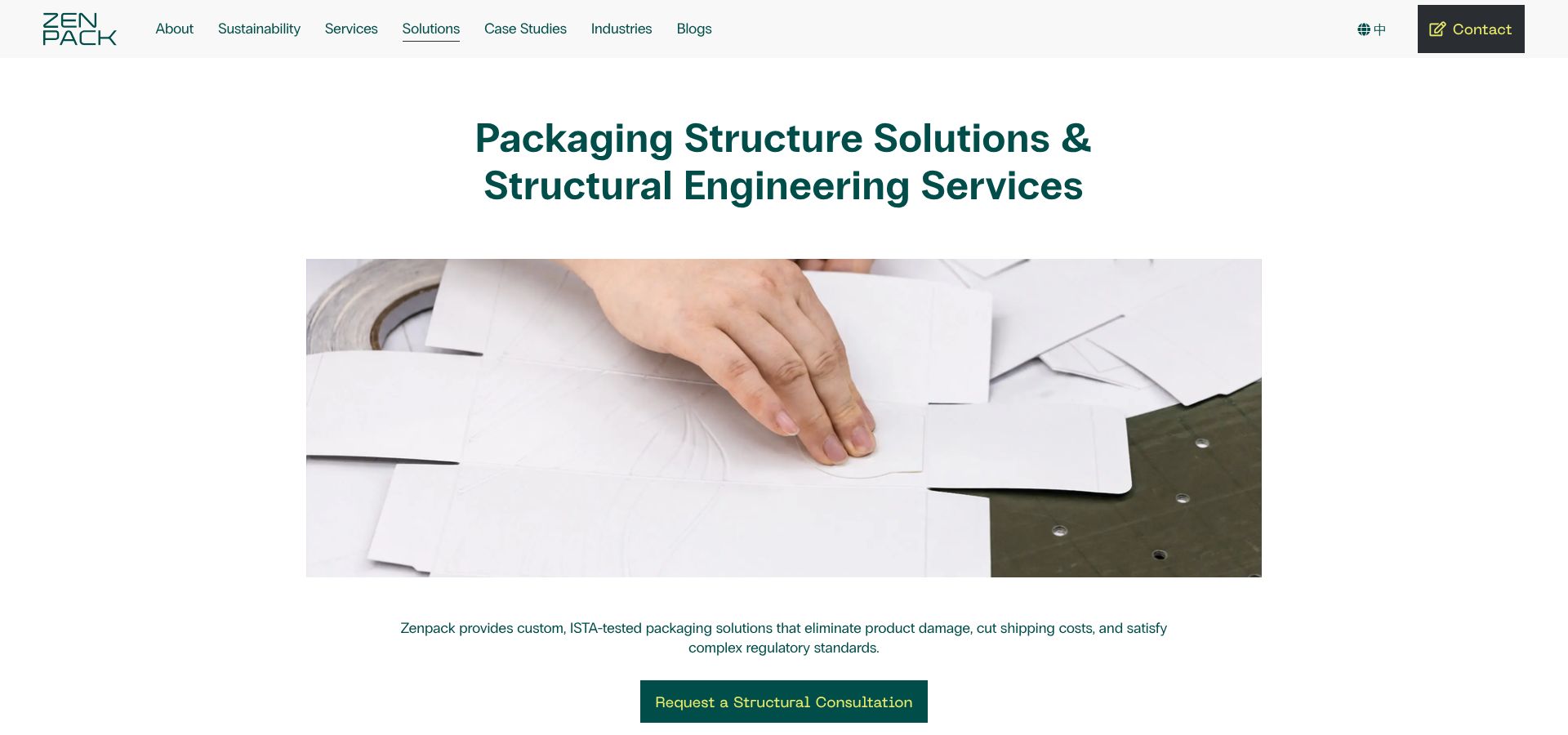
An integrated partner from strategy through freight, Zenpack combines brand-level creativity with hands-on engineering. Headquartered in San Jose, the firm begins every project with collaborative workshops and 3-D CAD, then cuts prototypes on a Kongsberg table and runs ISTA drop and vibration tests before tooling. Brands comparing full-service partners can use Zenpack’s packaging structure solutions page as a checklist for CAD hand-offs, prototype checkpoints and IP terms.
Proof points
Olive Oil Jones ships glass bottles in custom-folded corrugated inserts that replaced foam and molded pulp cushioning, passed ISTA testing and eliminated breakage.
Cambio Coffee's molded pulp container turns into a countertop recycling bin once opened, a design that won a 2024 iF Design Award.
Zenpack earned Gold and Silver at the 2026 Pentawards for VSSL Outdoor Coffee Brewing Kits and Wicked × Kristin Ess Hair packaging.
Commercial model
Zenpack scopes each project to the brief, with scope rising as prototypes, tooling or multi-SKU families are added. Zenpack states that brands retain total ownership of all custom structural designs and patents, which preserves sourcing flexibility if economics shift.
When Zenpack is a fit
Beauty, lifestyle, coffee and premium electronics brands that want one accountable team for structure, testing and global production, and want the speed of one integrated partner from first sketch to mass production.
Watch-outs
Bring launch dates and channel requirements to the first workshop, so prototype rounds and ISTA tests fit the tooling schedule.
Agree hand-off formats for CAD and dielines up front if you plan a second production source later.
2. Adept Group: best for building an external packaging department
Adept Group acts as a full packaging department on demand. From its Bethlehem, Pennsylvania headquarters, the consultancy supplies contract engineers, Centers of Excellence, or entire managed teams that flex as backlogs rise or compliance deadlines tighten. Adept now brings 60 specialized areas of expertise that span design, testing, automation, sustainability, and regulatory strategy.
Proof points
A Fortune 500 CPG brand saved US$6.23 million annually by identifying alternative packaging suppliers and qualifying a third-party manufacturer.
A sleeve-pack redesign delivered a 25 percent per-pallet cost reduction and US$895,000 in annual savings while eliminating cut-related quality issues.
Commercial model
Adept scopes every engagement individually. Options range from a fixed-fee project to a staff-augmentation contract or a fully outsourced Center of Excellence. Public rate cards are not published, so expect NDAs and a data exchange before pricing arrives.
When Adept is a fit
Select Adept when overlapping launches, EPR filings, or systemic cost targets stretch your internal bandwidth. The firm excels at measurable optimization and compliance across multi-SKU portfolios.
Watch-outs
Enterprise-grade processes and pricing can exceed the needs of a single-SKU start-up. Confirm the team mix and escalation path before signing.
3. Fuseneo: best for innovation, prototypes and Amazon-ready e-commerce packaging
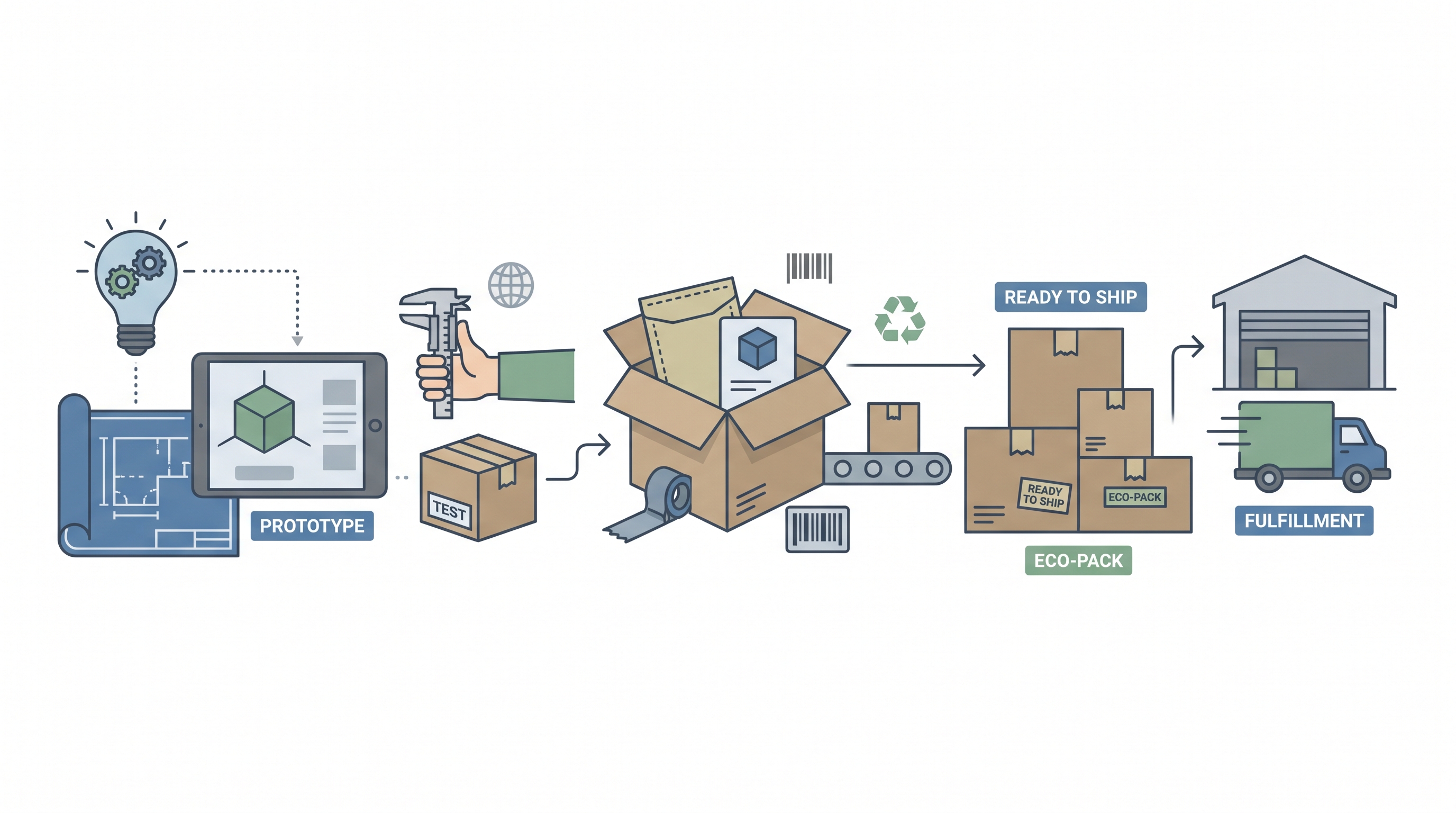
Fuseneo pairs industrial design, consumer insight and rigorous engineering to create packs that delight buyers and survive the last mile. In its own studio, the team runs 3-D printers, CNC routers, thermoformers and molded-pulp presses, enabling same-day iteration from CAD to in-hand samples.
Proof points
For OXO, a right-size redesign delivered 113 percent more units per pallet and 38 percent less packaging weight, cutting freight and material impact in one move.
The firm runs its own on-site testing lab that checks packs against UN, ISTA and ASTM standards, which streamlines SIOC or SIPP preparation.
Commercial model
Work usually starts as a fixed fee project. When clients place production through Fuseneo’s supply network, the studio folds design costs into unit pricing, removing the upfront design line item. Confirm design portability and tooling ownership before you commit to that path.
When Fuseneo is a fit
Choose Fuseneo for projects where rapid prototyping, Amazon compliance or consumer unboxing sits on the critical path, and measurable cube, weight or damage reduction is a priority.
Watch-outs
Production-linked pricing can limit supplier flexibility, so negotiate file ownership and alternate-vendor rights early.
Standard rate cards are not public, which means budget range must be scoped case by case.
4. Berlin Packaging / Studio One Eleven: best for bottles, jars and global sourcing
Berlin Packaging’s Studio One Eleven pairs its in-house design and innovation team in Chicago with Berlin Packaging's global sourcing network. The result is a straight path from concept sketch to delivered container.
Proof points
For hair-care brand Amika, custom refillable bottles cut the packaging carbon footprint by 69 percent over one year compared with two PCR plastic bottles, according to an independent LCA.
In 2026 the company earned 26 packaging awards across NACD, PAC Global and WorldStar competitions, signaling both creative and technical recognition.
Commercial model
Studio design fees drop to zero when the customer commits to purchasing packaging through Berlin. Lower upfront cash is the upside, while portability is the trade-off. Confirm who owns molds, minimum annual volumes and how resin-price swings affect unit cost.
When Berlin is a fit
Choose Berlin when primary-packaging complexity (glass, PCR PET, custom pumps, bar-top closures) and global volume matter more than strict supplier neutrality.
Watch-outs
“Free” design comes from margin in the supply contract, so scrutinize total landed cost and mold-ownership terms.
Very small runs may not reach the volume thresholds that unlock fee waivers.
5. TEN-E: best for fractional engineering with accredited lab support
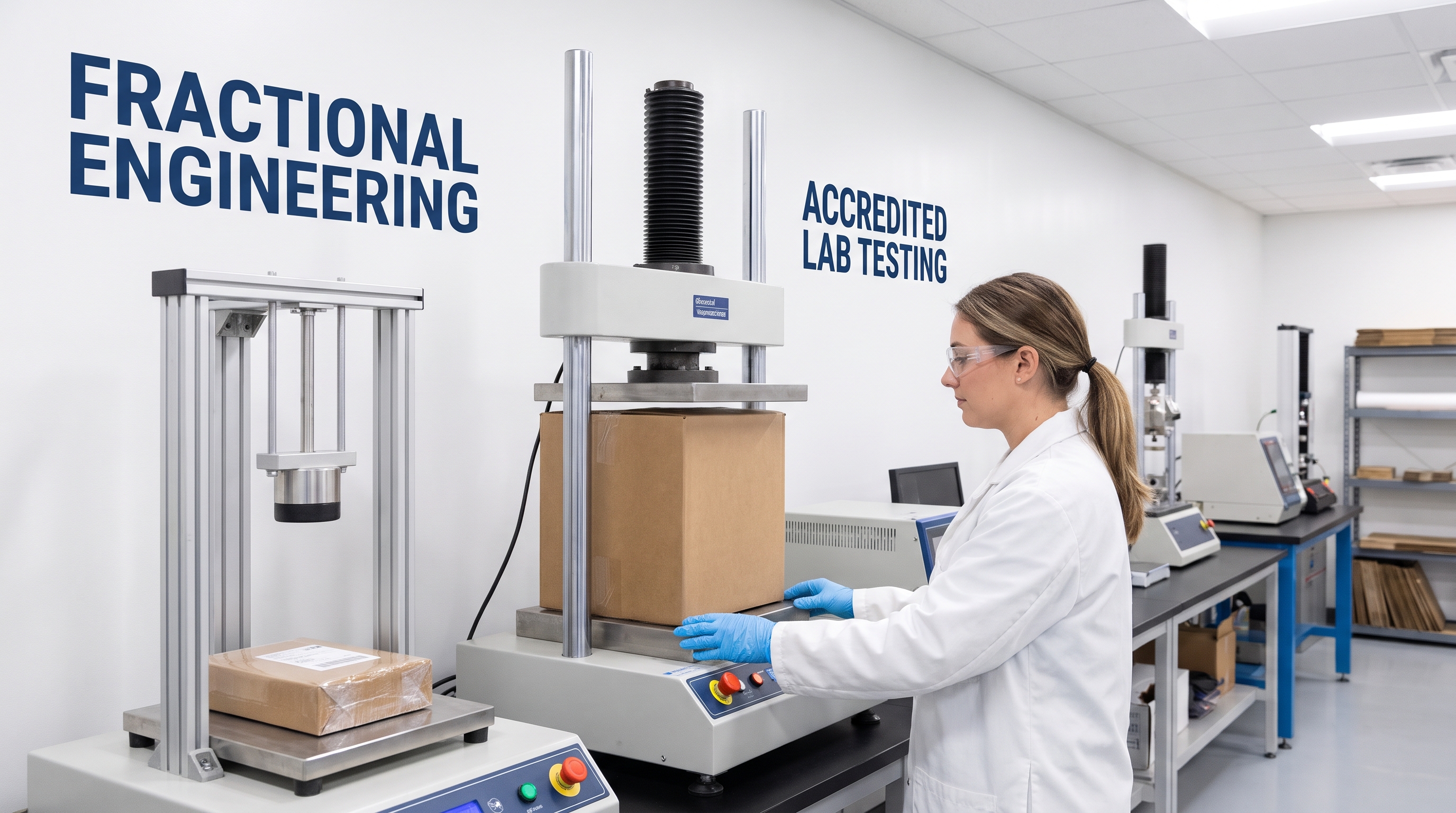
TEN-E lets brands rent senior packaging expertise by the month and tap ISO 17025 accredited labs only when tests are needed.
Proof points
In business since 1989, the employee-owned firm now operates three ANAB accredited U.S. labs plus a South African affiliate, covering ISTA, ASTM, ISO and Amazon APASS protocols.
The Packaging Solutions Group, launched in 2026, offers independent engineering and consulting that sits apart from testing services.
Fractional engagements typically start within one to two weeks of scope agreement, providing rapid capacity relief.
Commercial model
The firm bills support as a fixed monthly retainer tied to reserved engineering hours; travel, lab time and prototypes flow through at cost. Longer commitments can qualify for preferred rates.
When TEN-E is a fit
Ideal for brands that need senior engineering and accredited testing without a manufacturing contract, such as e-commerce damage reduction, ISTA 6/Amazon qualification or EPR data preparation.
Watch-outs
The consulting arm is new, so ask for category-specific references and clarify IP ownership (CAD, test data, change-control documents) before sign-off.
Public consumer-brand case studies remain limited; validate depth in your market.
What outsourced packaging engineering should actually include
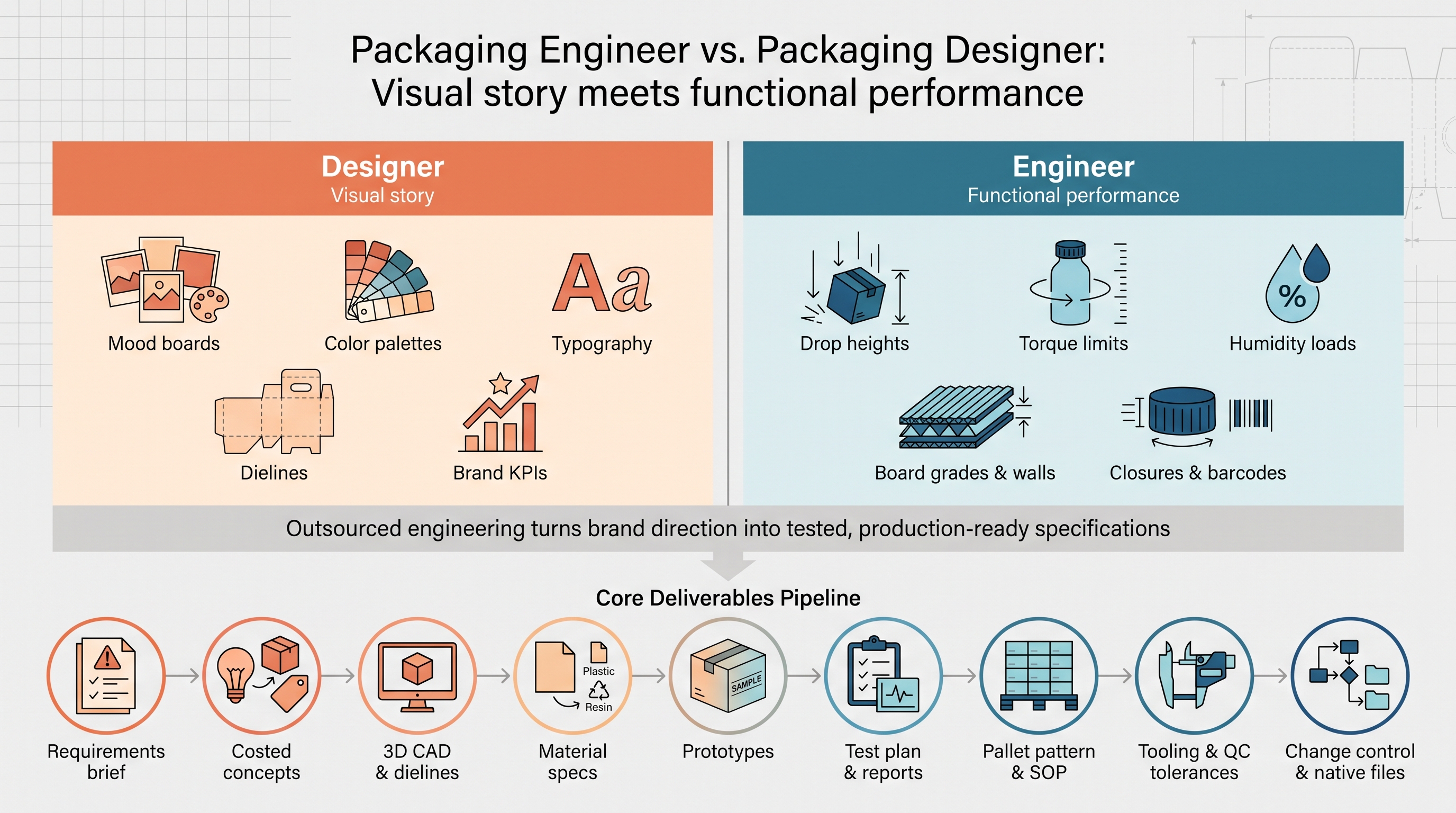
Packaging engineer vs. packaging designer
Designer focus: visual story
Mood boards, color palettes, typography, dielines and KPIs such as brand recognition and conversion.
Engineer focus: functional performance
Inputs such as drop heights, torque limits and humidity loads become board grades, wall thicknesses, closure tolerances and barcode-legibility specs.
Both disciplines matter. A lipstick that looks premium but leaks becomes a return, while a corrugated shipper that passes ISTA-6 yet resembles a moving box undermines shelf appeal. Outsourced engineering bridges the gap, turning brand direction into specifications that run smoothly at commercial line speeds and stay recyclable at end of life.
When to hire an in-house engineer instead
Outsourcing works best when launches are sporadic and budgets lean, but the balance tips once three triggers align:
Sustained workload: packaging tasks appear in every sprint, and line trials or EPR data requests queue up weekly.
Annual external spend: when yearly consulting fees climb toward the fully loaded cost of two to three full-time engineers with benefits, salaried staff usually become the cheaper and steadier option.
Strategic IP value: if structural innovation is core to brand differentiation, keeping expertise inside the business protects know-how and accelerates iteration.
Keep outsourcing for episodic capacity gaps; bring the function in-house when work becomes constant, mission critical and financially on par with headcount.
Deliverables to expect
A competent outsourced engineer leaves a transparent paper trail that converts tacit shop-floor knowledge into shareable assets:
Requirements brief covering product hazards, retailer mandates and EPR data
Costed concepts, refined to a single option with 3-D CAD, dielines and a gram-level bill of materials
Physical prototypes at the fidelity required for stakeholder sign-off
Written test plan mapping ISTA, ASTM or retailer protocols, plus accredited pass or fail reports
Pallet pattern, pack-out SOP, tooling drawings, quality tolerances and change-control flowchart
Native design files and test data, enabling competitive bids if economics shift
Any proposal missing these elements risks turning a clever idea into an expensive rework during scale-up.
Four ways to engage an external engineer
Outsourced packaging services usually fall into one of four commercial lanes:
Independent project consultancy: fixed fee for strategy, CAD, testing and specifications. Ownership is clear, and the design can be bid to any converter; best for finite launches or single-SKU fixes.
Fractional (embedded) engineer: part-time capacity on a monthly retainer. The engineer joins meetings, writes SOPs and oversees tooling, then rolls off when demand subsides, which is cost-effective when workload is erratic.
Design-to-manufacture partner: one firm handles ideation through container load inside its own plants or a tight supplier network, trading some supplier neutrality for speed and accountability (for example, Zenpack).
Supplier-integrated service: engineering fees disappear because margin sits in the packaging order, attractive for cash flow but dependent on mold ownership, MOQs and long-term volume commitments (for example, Studio One Eleven).
Which provider fits your situation?
Match the partner to the gap, not the resume:
Zenpack: best when brand experience and structural rigor must travel together, ideal for beauty, coffee or premium electronics with tight launch windows.
Adept Group: the plug-in department for overlapping launches and looming EPR deadlines, scales from a single expert to a multi-disciplinary team.
Fuseneo: call when rapid innovation, Amazon SIPP compliance or cube reduction tops the brief, prototype sprints convert ideas into ship-ready packs fast.
Berlin Packaging / Studio One Eleven: choose for bottles, closures or refill systems when a design plus global sourcing bundle outweighs strict supplier neutrality.
TEN-E: opt for fractional senior engineering and accredited test reports without adding payroll, shines when transit risk spikes and workload stays lumpy.
How much does outsourced packaging engineering cost?
Pricing falls into four broad models, each with its own cash-flow profile.
Independent consultants: published rates run US$75-150 per hour for tactical CAD cleanups, while full commercialization programs often start in the low five figures.
Fractional retainers: firms such as TEN-E reserve senior-engineer hours for a fixed monthly fee, and lab work or travel flows through at cost. The fee is predictable for finance teams, but scope spikes must be scheduled in advance.
Design-to-manufacture partners: Zenpack scopes each project to the brief, and budgets grow as prototypes, tooling or multi-SKU rollouts enter it. The upside is speed: one purchase order covers strategy through freight.
Supplier-integrated services: studios like Berlin Packaging’s Studio One Eleven waive design fees when packaging volume meets preset thresholds. Margin shifts to unit price and tooling, so brands must model total landed cost.
Before signing, list every downstream expense the fee could offset: tooling errors, charge-backs, damage claims or launch delays. The cheapest line item on paper often becomes the most expensive once freight, rework and lost shelf time show up.
12 Questions to Ask Before You Sign
A clear request for proposal protects budget, schedule and intellectual property long after the kickoff call. Use the checklist below to surface hidden costs or scope gaps before any prototypes are cut.
Who performs the day-to-day engineering work, and what qualifications do they hold?
Are those resources employees, contractors or third-party partners?
Does the firm receive commissions or margins from any material or converter it recommends?
Who will own CAD files, dielines, tooling, test data and patents at hand-off?
Can the design be competitively bid to other suppliers without extra fees?
Which laboratory tests are included in the quote, and which are billable add-ons?
Is the test lab accredited to ISTA, ASTM or other relevant standards?
Will an engineer attend plant trials and first production runs, and how is that time billed?
Can the provider supply material weight data, recyclability evidence and state-specific EPR fee calculations?
How will change requests be managed once tooling has begun?
What happens if workload exceeds the monthly retainer or fixed project scope?
May the client speak with two recent references that launched similar products or volumes?
Pose these questions in every shortlist conversation to turn vague proposals into crisp, comparable answers.
90-Day Outsourced Packaging Engineering Plan
Ninety days is often enough to audit the current pack, build and test prototypes, and lock specifications before tooling deposits are due. The timeline below groups the work into four sprints, each lasting two to four weeks.
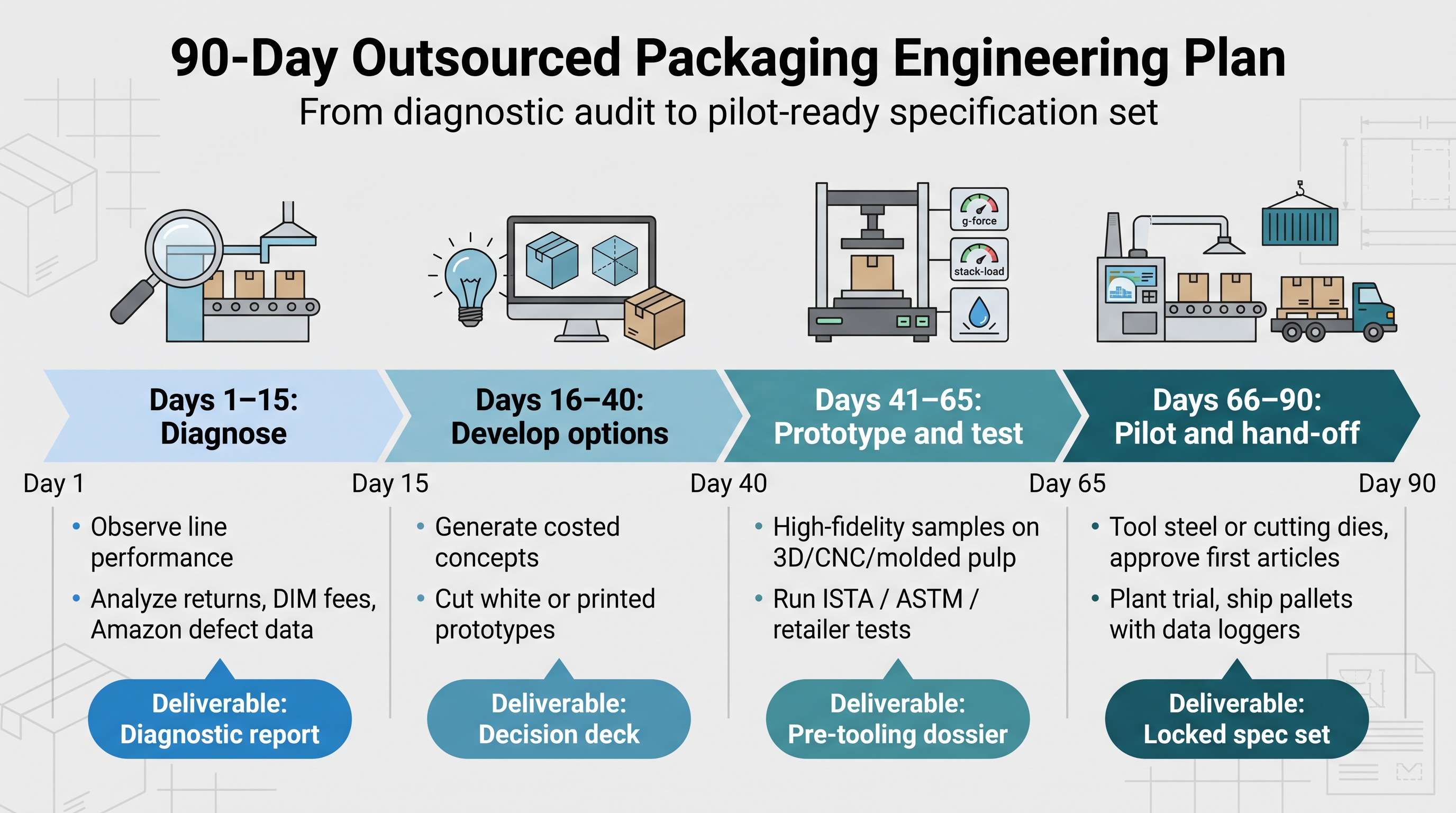
Days 1-15: Diagnose
Observe line performance: erecting, filling, capping, changeovers, scrap.
Pull six months of damage returns, DIM fees and Amazon defect data.
Record component weights against state EPR and EU PPWR matrices.
Collect launch calendars, forecast volumes and retailer test requirements.
Deliverable: diagnostic report covering baseline costs, pain-point hierarchy, regulatory gaps and success metrics.
Days 16-40: Develop options
Generate three to five concept routes with quick, costed BOMs.
Move the lead ideas to CAD, then cut white or printed prototypes for review.
Run scenario math on PCR percent, cube reduction and pallet efficiency.
Deliverable: decision deck with one lead concept, a fallback option, updated costings, draft test plans and projected EPR fees.
Days 41-65: Prototype and test
Produce high-fidelity samples on CNC routers, 3-D printers or molded-pulp tools.
Run functional checks, then ISTA, ASTM or retailer sequences.
Log g-forces, stack loads and color shifts, then roll failures back into CAD for fixes.
Deliverable: pre-tooling dossier with validated spec, full test reports and “green” status on damage, pallet density and fee targets.
Days 66-90: Pilot and hand-off
Tool steel or cutting dies, approve first articles and document tolerances.
Execute a short plant trial on live equipment, capturing speed, scrap and operator feedback.
Ship pallets on final carrier lanes with data loggers to confirm vibration profiles.
Finalize BOM, 2-D/3-D CAD, color targets, pack-out SOP and change-control flow.
Deliverable: locked specification set, launch calendar and cost baseline, ready for purchase orders and scale-up.
Packaging Requirements Your Partner Should Prepare for Now
1. Seven U.S. states have enacted packaging EPR laws
California, Colorado, Maine, Maryland, Minnesota, Oregon and Washington have enacted extended-producer-responsibility laws, each with its own fee formula and reporting calendar. Oregon and Colorado began enforcing theirs on July 1, 2025, while California, Minnesota and Washington phase in between 2027 and 2029. An engineer should track component weights by SKU from day one, so future fee updates or new resin surcharges stay a spreadsheet fix, not a tooling rebuild.
2. EU PPWR applies from 12 August 2026
The Packaging and Packaging Waste Regulation entered into force on 11 February 2025 and began applying across the EU on 12 August 2026. It sets mandatory rules for eco-design, recycled content, waste prevention and reuse, and aims to make all packaging on the EU market recyclable in an economically viable way by 2030. An “EU first, localize later” design strategy prevents duplicate tooling.
3. GS1 Sunrise 2027 readies retail checkouts for 2-D barcodes
GS1 US's Sunrise 2027 initiative supports retailers in making sure their point-of-sale systems can read and process 2-D barcodes, such as QR codes, as brands add them to packaging. Quiet zones, substrate gloss and dual-carrier layouts (UPC plus 2-D) must land in artwork early or risk an expensive late-stage relabel.
4. Amazon SIPP rewards right-size, test-proven packs
In 2025, Amazon certified 28 million unique products for its Ships in Product Packaging (SIPP) program and shipped them to customers in North America and Europe, and 11 percent of its orders worldwide went out without any additional Amazon packaging. Since February 2024, sellers using Amazon's fulfillment network in those regions can also certify their packs, so designing for SIPP from the first prototype avoids a costly redesign later.
Red Flags When Evaluating a Packaging Engineering Firm
Beautiful renders, no test plan: style without drop, vibration or compression protocols signals future freight damage.
Buzzword sustainability: demand quantified grams saved, PCR percentages or LCA results; empty “ocean plastic” claims add risk.
Vague ownership terms: unclear rights to CAD, tooling or test data can hide supplier lock-in or future release fees.
No change-control process: regulations, materials and line speeds evolve, and lacking a documented revision path shifts rush-fee risk onto the brand.
Unavailable references: credible firms provide recent, category-relevant contacts on request; silence is a warning sign.
Frequently Asked Questions
What does an outsourced packaging engineer actually do?
They convert marketing goals and regulatory constraints into physical reality. Tasks range from drop-test planning to material-weight mapping for state EPR reports, all while keeping line speed, landed cost and launch dates on track.
How do I know if outsourcing is right for my brand?
If packaging work arrives in bursts such as holiday bundles, retailer exclusives or new Amazon ASINs, outsourcing lets capability scale up and down quickly. When projects become continuous and external fees approach the cost of two full-time engineers, in-house hiring makes more sense.
What does it cost?
Public examples show hourly rates of US$75-150 for tactical CAD, with full commercialization programs starting in the low five figures. Fractional retainers sit between these poles and offer predictable spend with room for project spikes.
What kind of ROI is realistic?
Look beyond unit price. Adept Group’s sleeve-pack redesign cut packaging cost 25 percent per pallet and saved about US$895,000 per year by eliminating knife use on the line.
Do redesigns really pay for themselves?
Yes. Fuseneo’s OXO project increased pallet density 113 percent and reduced pack weight 38 percent, shrinking freight and material cost in one move.
Is outsourcing only for start-ups?
No. A 2026 Packaging World survey found 42 percent of brands plan to increase external manufacturing and packaging during the next two to three years.
Who owns the tooling and CAD files?
Ownership depends on the contract. Independent consultants usually transfer everything at final payment, while supplier-integrated models may retain mold ownership or charge a release fee.
Can one partner handle design, sustainability and regulatory filings?
The five providers profiled here can, but depth varies. Request examples such as delivered EPR data sets, PPWR-ready labels or published LCA comparisons.
How long does a typical engagement take?
A single-SKU refresh with no new tooling can finish in six to eight weeks. Multi-SKU portfolios with new molds and retailer testing may run six months. The 90-day framework in this guide is a common midpoint.
Will outsourcing slow the launch?
Done well, it speeds things up by surfacing issues early and eliminating serial hand-offs. Brands must still supply samples, data and decision authority to keep momentum.
Where should I start tomorrow?
Draft a one-page brief with product dimensions, annual volume, channels, sustainability goals and known pain points. Send it, along with the 12 vetting questions in this article, to two shortlisted partners. Their replies will reveal fit faster than any sales deck.
Conclusion: start small, demand proof, scale with confidence
Outsourcing a packaging function is not an all-or-nothing leap. Leading brands start with a focused, paid diagnostic: a senior engineer audits the current pack, quantifies risks and opportunities, and delivers a roadmap that costs a fraction of a full redesign.
Next, shortlist two providers whose operating models match your bandwidth and launch cadence. Share the same one-page brief and the 12 vetting questions above; side-by-side answers will expose alignment on freight, EPR fees and line efficiency.
When a partner proves product protection, price discipline and regulatory compliance at pilot scale, expanding the relationship becomes routine. Hours once lost to damage claims can shift to on-time shipments and continuous improvement.
Ready to proceed? Turn the 12 questions above into a one-page RFP scorecard, send it to the finalists, and turn packaging into a competitive edge.
About FittDesign
FittDesign is a full-service design and production company for sportswear and activewear brands. We take you from the first sketch to a factory-ready tech pack, sampling and production, so the product that arrives is the one you pictured.
Get a quote → Takes 2 minutes. No obligation.