

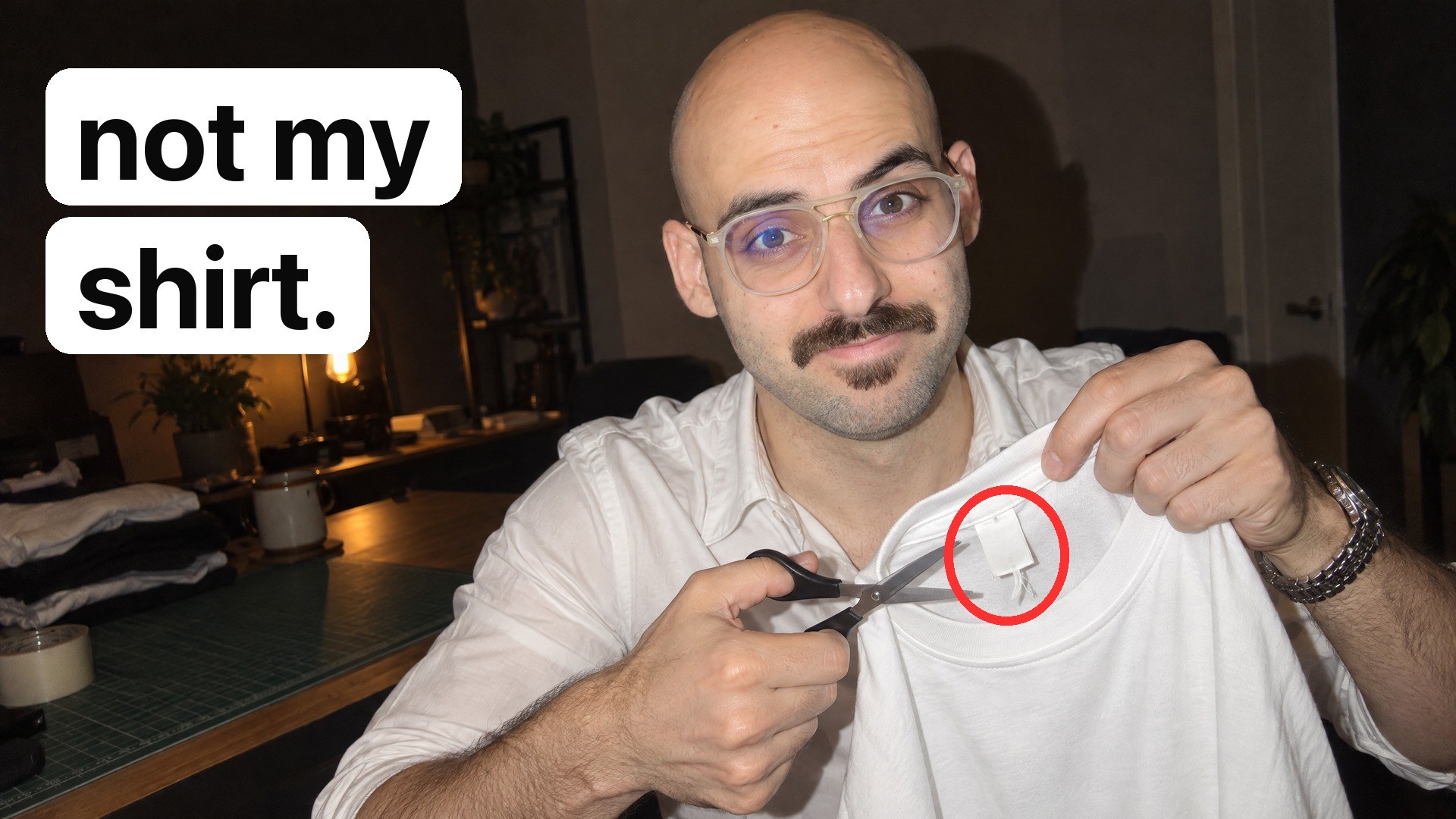
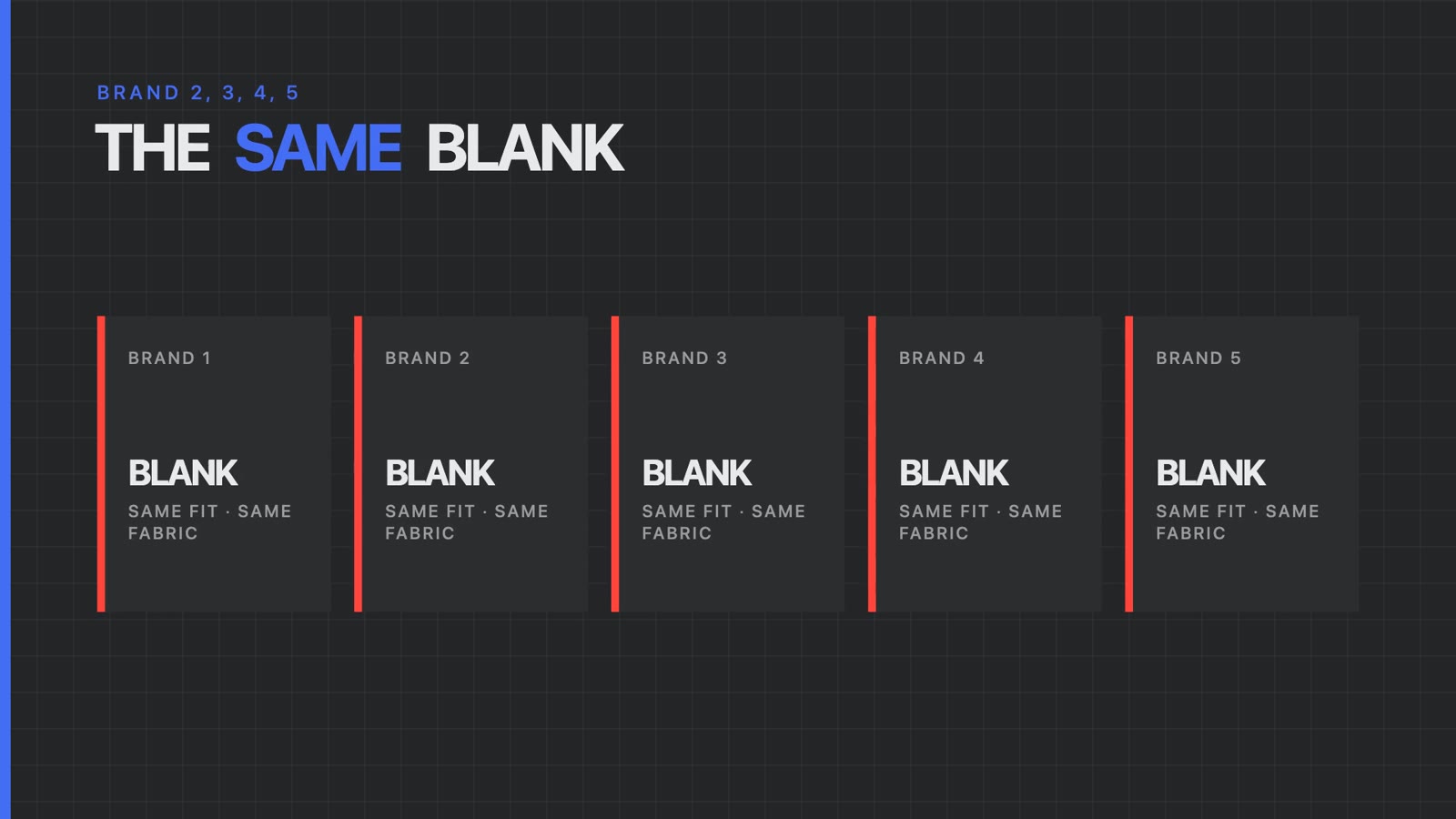
Your first drop sold out in a weekend. Fifty blank t-shirts with your logo on them, maybe from your favorite printer, maybe a local print shop, maybe an online retailer. Then you look at brand two, three, four and five, and they're all on the same blank. Everything looks the same, and you start wondering whether this is the way to keep going.
Shadi Adada, co-founder and creative director of FittDesign, has spent the last 10 years helping thousands of brands go from a design idea to a physical product, and FittDesign only builds custom, bespoke product. He sees brands stuck on blanks every week, limited by the size of print, the color and the fabric, and hesitant about whether now is the right moment to invest in stock.
The short answer: blanks are a good way to test, and cut and sew is how you own a product. Shadi recommends switching the one style that has proven itself first, with a tech pack behind it, while the rest of the range stays on blanks.
Prefer to watch? The full episode is embedded at the bottom of this post, along with the complete script.
1. What a Blank Is
A blank is a finished garment, already cut and sewn, available in bulk from a retailer. You select the color and the silhouette, then put your logo on it wherever you want.
- It's usually very fast, because the product already exists in someone else's warehouse.
- Minimums are low, since it's just a matter of picking it out of the box and decorating it.
- The fits tend to be quite universal, because someone has already worn and tested them.
The cost varies a lot from retailer to retailer, and that's where the comparison with cut and sew gets interesting.
2. What Cut and Sew Is
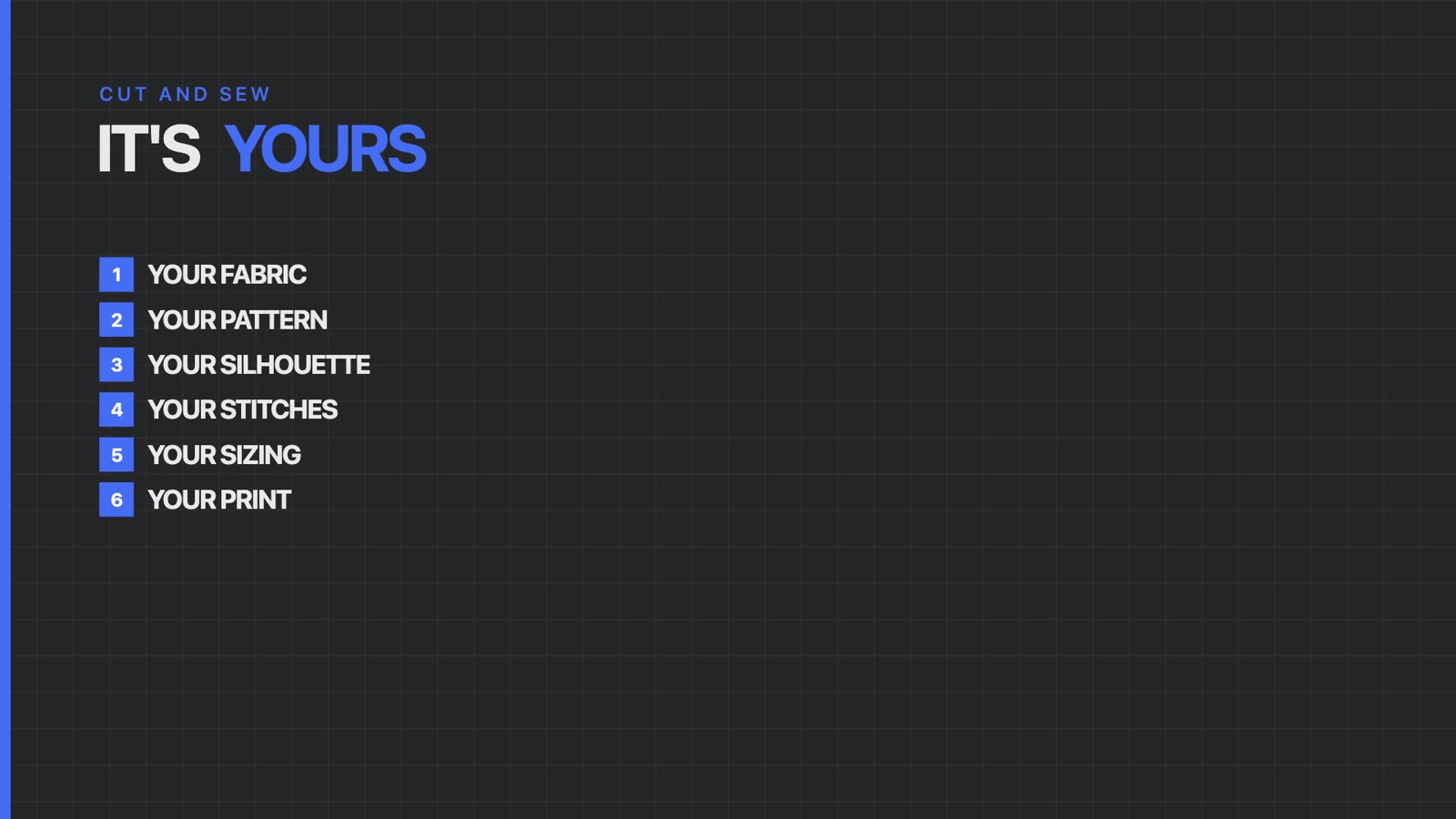
Cut and sew is what it sounds like. It's your fabric, your pattern, your silhouette, your stitches, your sizing and your print, sewn together. You create a tech pack, you make a sample, and then you create the bulk production.
At the end of it you own the product. Shadi calls it a piece of fashion real estate that nobody else has access to unless they reverse engineer it. A competitor can't look it up on a print-on-demand service and put their own logo on it.
3. The Cost per Piece
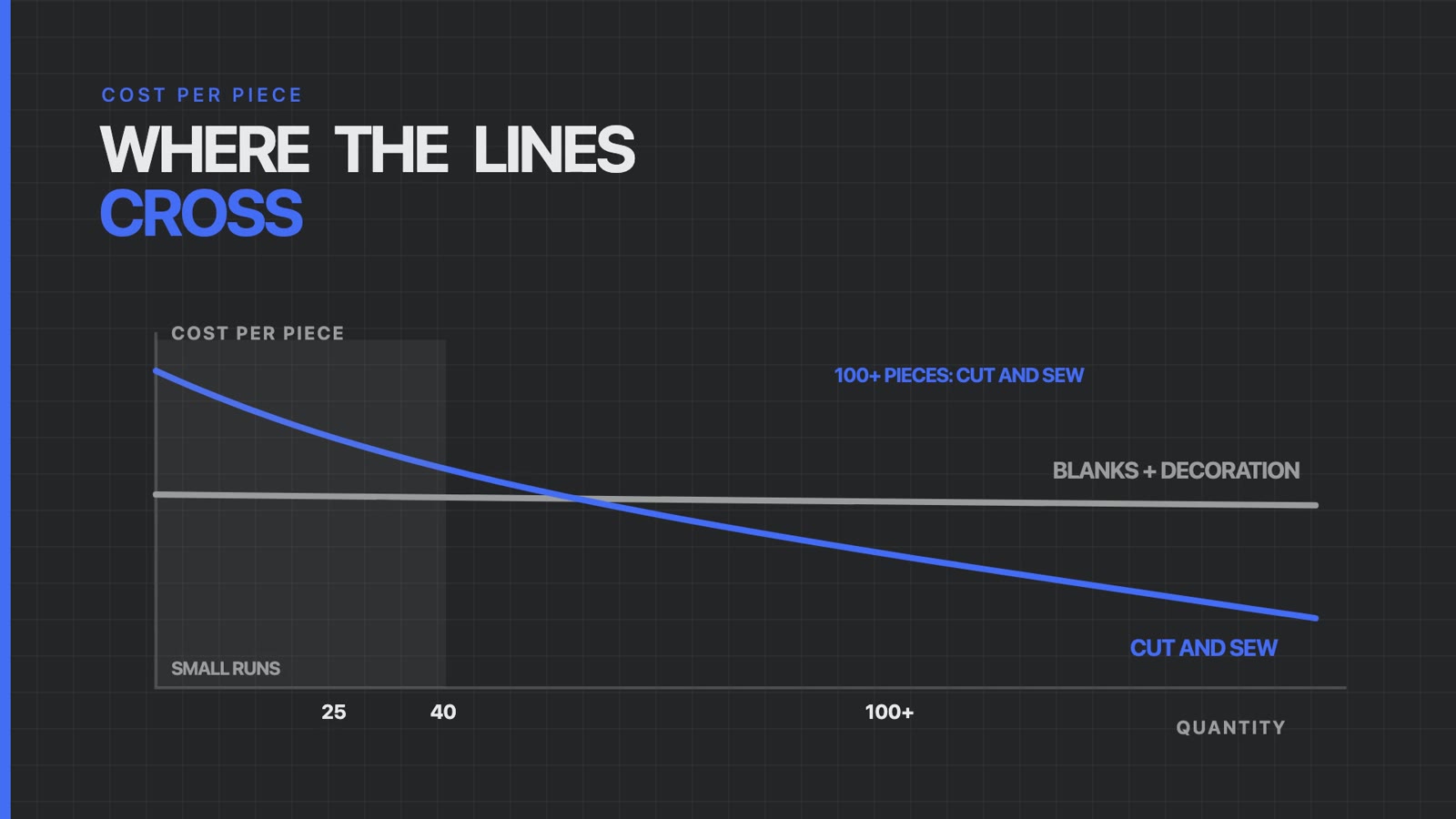
With very small numbers, somewhere between 0 and 25, 35 or 40 pieces max, blanks plus decoration sometimes make more sense and tend to be a little cheaper per piece, although that's not always the case.
Really high quality cut and sew, with a good selection of fabrics and none of the limitations of blanks, usually needs you in the 100 plus region. That sounds like a lot, but it's an accessible point for a lot of brands, and it's where brands thinking about the long run start building a product they can really stand behind.
Cut and sew usually drops in cost per piece as you scale, because setup costs like screen print setup and mold setups get spread over a larger quantity. Blanks don't get that. And as soon as you want something the blank retailer doesn't offer, like a woven hem tag or a printed neck label, it can cost an arm and a leg, because it's not something they do.
Thinking about your first cut and sew style?
The fabric, the fit and the trims all get settled in the tech pack before the first sample, so the piece that comes back is the one you pictured.
4. What Customers Can Tell
A blank fit is one you've seen before, like Fruit of the Loom or American Apparel back in the day. It's very generic and fits everyone a little. If you're building an activewear brand where customers tend to be broad in the chest and shoulders, a generic blank fit may feel out of place or a bit too tight.
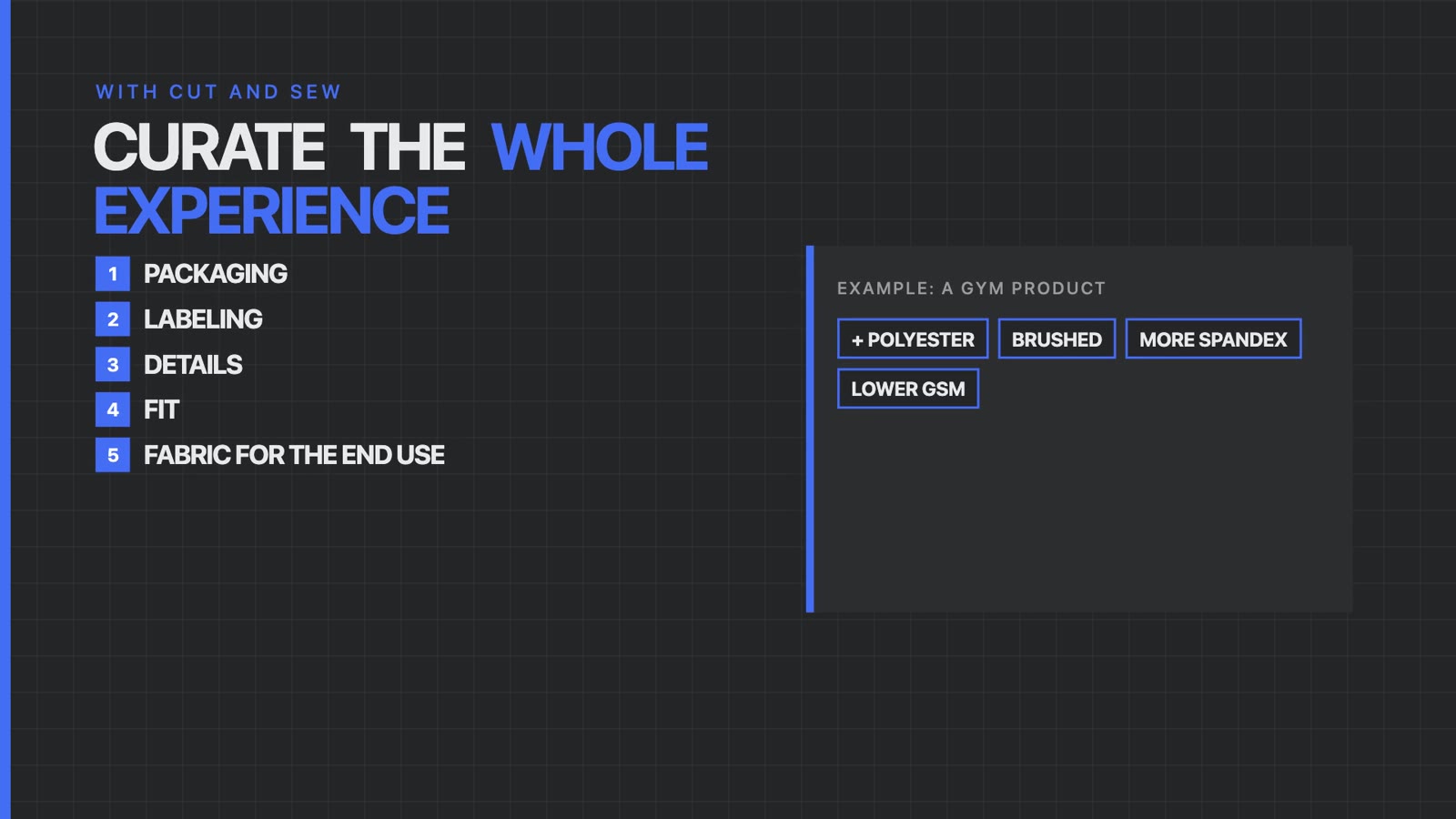
Customers feel the fabric weight, the hand feel and the neck label, and they read those as quality indicators. With cut and sew you can curate the whole experience, including the packaging, the labeling, the details and the fit, and tailor the fabric for the end use. For a gym product, that might mean a little polyester, a brushed finish, a bit more spandex or a lower GSM.
5. The Signs It's Time to Switch
- You keep getting reorders on the same style. You've proven it, so you can meet the minimum, make a better product and probably bring your price down.
- Customers keep asking for the same adjustments on your blank fits, like a slightly longer body or a thicker fabric.
- Decoration costs are eating into your margins as you scale, because blanks don't give you economies of scale the way cut and sew does.
If you recognize two of these, Shadi says you're ready to make the switch.
The Verdict: One Hero Style First
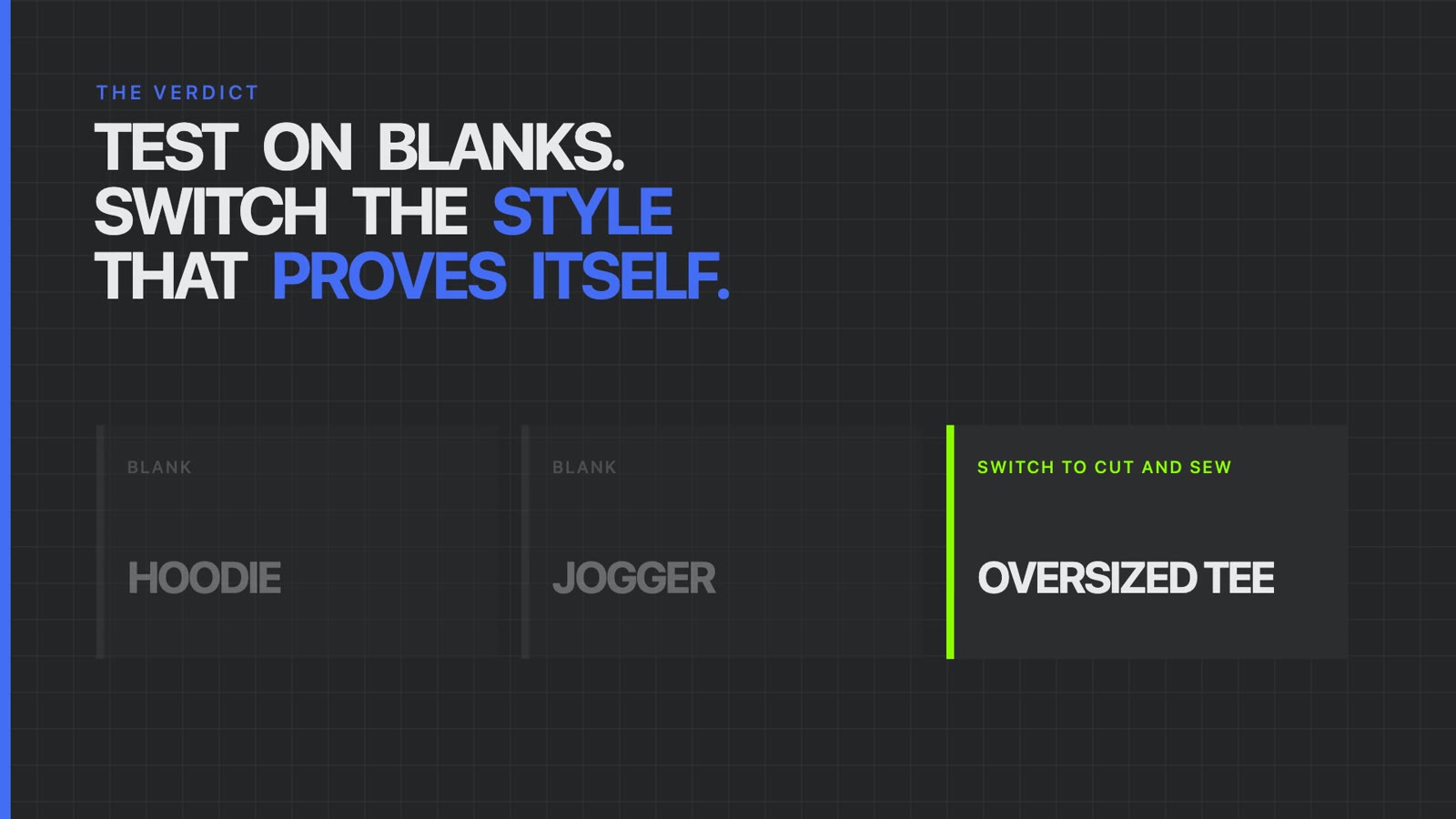
Test on blanks, and once you have proven demand, switch the style that has proven itself, not the whole range. If you have a hoodie, a jogger and a t-shirt on blanks and the oversized t-shirt keeps selling, that's the one to move over, then keep making it better.
If you're going into cut and sew from the start because you want to create something specific, Shadi recommends a hero style or a hero outfit first rather than recreating an entire range. With blanks it's easy to keep adding products, but more variety doesn't necessarily mean better, especially in a competitive market. Knowing your USPs and building products around them matters more.
🎬 Watch the full episode. Shadi walks through every stage, with the cost chart and the signs to look for. Watch on YouTube

Full Episode Script
This is the script of the episode as Shadi delivered it, lightly edited for reading.
Intro
So let's just say that your first drop sold out in a weekend. You had a pile of 50 blank t-shirts that you put your logo on, maybe from your favorite printer, maybe a local print shop, maybe an online retailer. You got your sick design on it and you're so proud.
But then you look at brand two, three, four, five, and they all have the same blank. Everything looks the same, and you catch yourself wondering: I sold through these products, but long term, is this the way to go? Do I just keep printing designs on this t-shirt and call it a day, or is there a better alternative?
Well, maybe it's a little bit of both. Maybe there is a better alternative, and when you should make the switch might be a lot sooner than you considered. In this episode we'll be looking at the difference between working with blanks as an activewear or premium streetwear brand, and when the right time is to go for cut and sew, custom bespoke pieces that meet the needs of your customer and your brand.
My name is Shadi Adada, and over the last 10 years I've helped thousands of brands go from a design idea to a physical product, and we literally only build custom bespoke product. I've worked with a lot of brands that have come to us with challenges in scaling their business. They're desperate to go from blank pieces, where they're limited by the size of print, by the color, by the fabric, to something that really speaks to their customer. But they're hesitant about whether now is the right moment, and whether they should invest in the stock. So without further ado, let's get right into the episode.
1. What a blank is
Number one, we have to understand what a blank is. A blank is a finished garment that's already available in bulk from a retailer, already cut and sewn. You select the color, you select the silhouette from your manufacturer, and you put a logo on it wherever you want.
It's usually very fast, and there are low minimums, because these products already exist in someone else's warehouse. It's just a matter of them picking it out of the box and putting a logo on it. In general they tend to have fits that are quite universal. Someone's already worn the product and tested it, so the fit is generally approved.
In terms of what it costs, it depends from retailer to retailer, so there's a lot of variety in the cost. But when you compare it to your cut and sew options, this is where it gets quite interesting.
2. What cut and sew is
Number two, we have to understand what cut and sew is. Cut and sew is what it sounds like. It's your fabric, it's your pattern, your design, your silhouette, your stitches, your sizing, and then your actual print or graphic, all sewn together. That means you create a tech pack, you make a sample, and then you create the bulk production.
And you own this product. You've created a piece of fashion real estate that really no one else has access to, unless they reverse engineer your product. It's something that competitor XYZ can't just look up on an online print-on-demand service and put their own logo on.
3. The cost per piece
Number three, you have to understand the cost per piece. When you're starting off with very, very small numbers, maybe 0 to 25, 35, 40 max, blanks plus decoration sometimes make a little bit more sense. They tend to be a little bit cheaper per piece, although that's not always the case when you compare them to cut and sew.
That's because with cut and sew, to get into really high quality cut and sew, where you have a really good selection of fabrics and none of the limitations you have with blank pieces, you tend to need to be in the 100 plus region. That's an accessible point for a lot of people, but maybe you're thinking, 100 pieces, that sounds crazy, I'd never be able to get up to that point. Bear with me a second. When you notice what you get in return for those 100 pieces, that's where brands that are thinking of the long run, and building a product they can really stand behind, find it very viable.
When it comes to cost per piece, cut and sew usually drops as you scale up production, because of economies of scale and the lower amortized cost of overheads like screen print setup and mold setups over a larger quantity.
With blanks, as soon as you want to start making adjustments or adding things your traditional retailer can't provide, because they don't have that setup, it's going to cost an arm and a leg to add something as simple as a woven hem tag or a printed neck label. It's just not something they do.
4. What customers can tell
Number four, we have to understand what customers can tell when they're comparing a blank to cut and sew. A blank fit is something you've seen, like Fruit of the Loom or American Apparel back in the day. It's a fit that's very generic. It fits everyone.
If you're creating a very activewear or sportswear focused brand, where customers tend to be broad in the chest and the shoulders, a generic blank fit may not work well for them. It may feel out of place, or a bit too tight. They're going to feel the fabric weight, the hand feel, the neck label, all the things that come up as quality indicators, and they'll understand that this is standard and generic.
When you're looking at cut and sew, you can really curate the entire experience from start to finish, including the packaging, the labeling, the details and the fit. You can tailor the fit for your customer and the fabric for the end use. If you're going for a gym-focused product, maybe you introduce a little bit of polyester. Maybe it's brushed polyester, a bit more spandex. Maybe you lower the GSM. If you're tailoring for a hotter market, there's a lot of flexibility and variety you can have.
5. The signs it's time to switch
For you, when is the time to switch? If you keep getting reorders on the same style over and over, that means you've proven it, and it might make sense to switch, because you can meet the minimum order quantity, make a better product and probably bring your price down.
Also, if customers keep asking for the same adjustments on your blank fits, maybe for it to be slightly longer, or for the fabric to be a bit thicker, that's a great sign.
And if the decoration costs eat into your margins as you scale, because with blanks you don't get the economies of scale you do with cut and sew, it might make sense to go cut and sew, where the cost of setting it up ends up being offset by the long-term volume you create. That's not something you get with blank production.
So if you have any of these, maybe even two of them, you're definitely ready to make that switch.
The verdict
So guys, what's the verdict here? You want to initially test on blanks, and once you have proven demand, switch the style that has actually proven itself, not the whole range. So if you have a hoodie, a jogger and a t-shirt, all on blanks, and you're getting consistent sales on the oversized t-shirt, consider switching that one over, and then look at how you can make the product even better.
My recommendation: if you're looking to get into cut and sew from the start because you want to create something specific, work on a hero style or a hero outfit first, rather than recreating an entire range, which you might be tempted to do with blanks. With blanks there are no minimums, so you can just add a jogger, a hoodie, a t-shirt. But more variety doesn't necessarily mean better, especially in a competitive market. You want to identify what your USPs are and create products that align with them.
Work with us 1-on-1
If you guys enjoyed this episode, please consider smashing a massive thumbs up. And if you're looking to get into the cut and sew space, maybe you've tried one too many blank retailers and you're not satisfied with the quality, the pricing, the service or the customization they're able to give you, maybe cut and sew is your answer. Check the link in the description to apply to work with us one-on-one, and within five minutes a real human will get back to you with a personalized production roadmap on how we can take your idea and turn it into a physical sample in under 30 days.
Guys, I say this from the very bottom of my heart, thank you so much for tuning in to this episode of FittDesign TV. Until next week's episode, stay awesome.
About FittDesign
FittDesign takes clothing brands from an idea to a physical product: design, factory-ready tech packs, sampling and production. A real person gets back to every inquiry within five minutes with a personalized production roadmap.
Ready to make your first cut and sew style?
Tell us which style is selling and we'll map out the fabric, the tech pack and the route to your first sample.
Get a quote → Takes 2 minutes. No obligation.